Microenvironmental Determinants of Reaction Kinetics in Biomolecular Condensates Probed with Protein Ligation

Microenvironmental Determinants of Reaction Kinetics in Biomolecular Condensates Probed with Protein Ligation
Bae, J.; Hong, K.; Lee, D.; Jun, J.; Jung, Y.
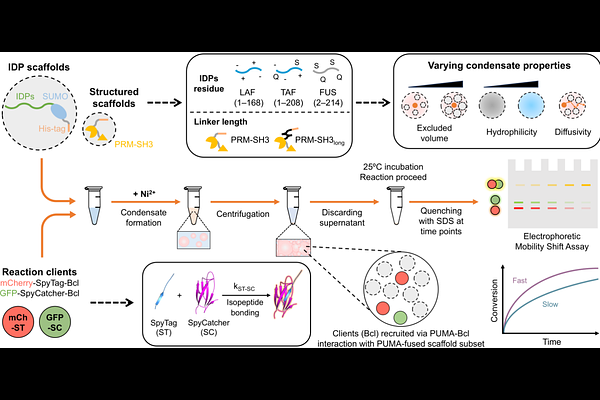
AbstractCells utilize liquid-liquid phase separation to organize biochemical reactions within biomolecular condensates, which function as membraneless organelles. Although these assemblies are known to enhance reaction rates by concentrating reactants, the mechanisms beyond simple mass-action effects remain poorly understood. Here, we examined how the physicochemical microenvironment within condensates modulates reaction kinetics using spontaneous protein ligation as a model reaction, conducting a systematic analysis across various condensates, ranging from structured scaffolds (PRM-SH3 systems) to intrinsically disordered protein (IDP)-based scaffolds such as LAF, TAF, and FUS. We designed a FRET-based proximity-sensitive client probe to quantify increases in effective local concentration arising from excluded-volume effects. In parallel, we measured internal hydrophilicity and water activity, revealing them as additional key determinants of reaction acceleration. Together, the findings presented here elucidate how phase-separated compartments regulate biochemical reactions through the interplay of physical (effective concentration) and chemical (hydrophilicity and water activity) microenvironments and provide mechanistic insights for engineering condensates with tunable reactivity.