NetTracer3D Enables User-Friendly Analysis of Diverse Microscopic and Medical 3D Datasets

NetTracer3D Enables User-Friendly Analysis of Diverse Microscopic and Medical 3D Datasets
McLaughlin, L.; Curic, M.; Sharma, S.; Villazon, J.; Salamon, R. J.; Yamaguchi, M.; Sequeira-Lopez, M. L. S.; Kennedy, P. R.; Lyons, R. C.; Shi, L.; Gomez, R. A.; Jain, S.
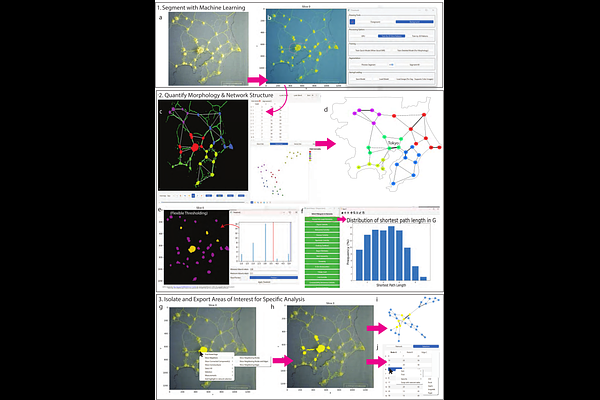
AbstractRecent advances in high-resolution imaging and spatial transcriptomics have enabled reconstruction of complex 3D tissue maps, providing unprecedented insights into cellular connectivity, organization, and tissue architecture. However, standardization challenges hinder integration, sharing, and analysis of these datasets across research communities. We developed NetTracer3D to simplify three-dimensional image analysis across diverse datasets. NetTracer3D is an integrated tool for defining, processing, and sharing 3D tissue maps with standardized data formats and interactive exploration capabilities. It provides three broadly applicable network analysis modalities: Connectivity networks for analyzing functional tissue units or cells connected via secondary structures such as nerves or vasculature; Branch Adjacency and Branchpoint networks for converting branched anatomical structures into analyzable representations; and Proximity networks for grouping structures by spatial relationships to identify cellular organization patterns. We demonstrate several use cases applying NetTracer3D to analyze multidimensional data from CODEX and label free Raman spectroscopy, multiscalar data encompassing subcellular and anatomical scales and a range of modalities. NetTracer3D was able to characterize neural relationships between functional tissue units in human and mouse kidneys and mouse bronchi. Branchpoint networks were used to identify vascular defects in human brain angiogram and define the innervation structure of a lymph node. Finally, we demonstrate how proximity networks characterize the tumor microenvironment in 3D light sheet cancer images and auto-detect cellular neighborhoods in multiplexed 2D CODEX datasets. Beyond network creation, NetTracer3D enables analysis, spatial statistics, and visual analytics tailored for volumetric tissue data. By establishing interoperable formats and analysis workflows, this work provides accessible and reproducible analytical tools for 3D spatial biology, enabling new discoveries of relationships between structure and physiology.