Ribonucleotide Reductase Inhibition Overcomes FLT3 Inhibitor Resistance in Acute Myeloid Leukemia

Ribonucleotide Reductase Inhibition Overcomes FLT3 Inhibitor Resistance in Acute Myeloid Leukemia
Tian, Z.; Wei, X.; Chatla, S.; Liu, Y.; Kim, D.; Li, Y.; Wang, P.; Liao, Y.; Liu, X.; Yang, D.; Octaviani, S.; Ma, G.; Pompetti, A.; Calendo, G.; Keough, M. P.; Xu, W.; Zhang, J.; Zheng, H.; Stieglitz, E.; Smith, C. C.; Huang, J.
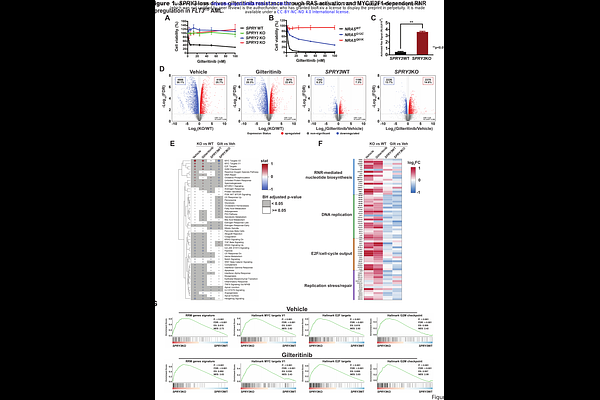
AbstractInternal tandem duplication mutations in FLT3 (FLT3ITD) occur in approximately 30% of patients with acute myeloid leukemia (AML) and are among the most common genetic alterations in this disease. FLT3ITD is a major driver of AML and associated with poor clinical outcomes. Although FLT3 inhibitors (FLT3is) have significantly improved outcomes for patients with FLT3ITD+ AML, acquired resistance remains a major barrier to durable clinical benefit. Reactivation of RAS/MAPK signaling, often driven by activating NRAS mutations, is a major mechanism of FLT3i resistance in AML; however, effective strategies to overcome this resistance remain lacking. Here, we identify ribonucleotide reductase (RNR) as a critical therapeutic vulnerability in NRAS-driven FLT3i-resistant FLT3ITD+ AML. Activation of RAS signaling through SPRY3 loss or oncogenic NRAS mutations confers robust resistance to FLT3is, pharmacologic inhibition of RNR with multiple inhibitors, as well as siRNA-mediated RNR suppression, reverses FLT3i resistance and restores FLT3i sensitivity across multiple FLT3ITD+ AML models in vitro. In vivo, clofarabine, an FDA-approved RNR inhibitor (RNRi), significantly overcomes NRAS mutation-driven FLT3i resistance; in combination with FLT3 inhibition, it markedly suppresses the progression of FLT3i-resistant AML and significantly prolongs survival in both cell line-derived xenograft (CDX) and patient-derived xenograft (PDX) AML models. Together, these findings identify a new vulnerability in FLT3i-resistant FLT3ITD+ AML and establish RNR inhibition as an effective strategy to overcome FLT3i resistance, supporting its clinical translation in this setting.