Multi-mission Investigation of X-ray Superorbital Modulation in the Supergiant High Mass X-ray Binary 4U 1538-52

Multi-mission Investigation of X-ray Superorbital Modulation in the Supergiant High Mass X-ray Binary 4U 1538-52
H. I. Cohen, N. Islam, R. H. D. Corbet, A. Lange, K. Pottschmidt, E. Bozzo, P. Romano, R. Ballhausen, C. Malacaria, J. B. Coley
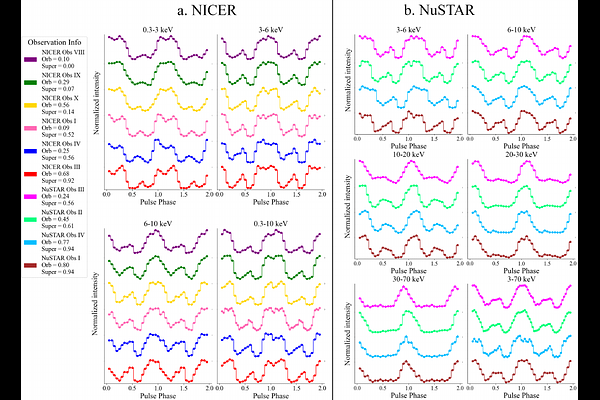
AbstractSuperorbital modulations has been detected in the supergiant High-Mass X-ray binary 4U 1538-52 using long-term monitoring with the Neil Gehrels Swift Observatory Burst Alert Telescope (BAT). The source also exhibits a long-term pulse period evolution as seen with Rossi X-ray Timing Explorer (RXTE), INTEGRAL, and Fermi Gamma-Ray Burst Monitor (GBM) that appears uncorrelated with changes in its X-ray flux. To investigate the mechanisms causing these superorbital modulations and its possible dependence on pulse period changes, we analyzed long-term monitoring with Swift-BAT and Monitor of All Sky X-ray Image Gas Slit Camera (MAXI-GSC) to construct dynamic power spectra and superorbital intensity profiles. In addition, we used pointed X-ray observations from Nuclear Spectroscopic Telescope Array (NuSTAR) and Neutron Star Interior Composition Explorer mission (NICER) to investigate the pulsation and spectral properties across different superorbital and orbital phase intervals. We find the presence of superorbital modulations in the MAXI-GSC 2-20 keV lightcurves, consistent with the periodicity observed with the Swift-BAT lightcurves. However, no significant changes are detected in the pulse profiles or spectral parameters across different superorbital, orbital, or pulse-change intervals. This lack of spectral or timing variations with orbital and superorbital phases suggests that the mechanisms driving the observed superorbital modulation and pulse period changes are likely associated with large-scale stellar wind structures, such as Co-Rotating Interaction regions, within the stellar wind of the supergiant companion.