The Imprint of Core-collapse Asymmetries on Supernova Shock Breakout

The Imprint of Core-collapse Asymmetries on Supernova Shock Breakout
David K. Khatami, David Vartanyan, Hai P. Le, Daniel N. Kasen, Adam Burrows
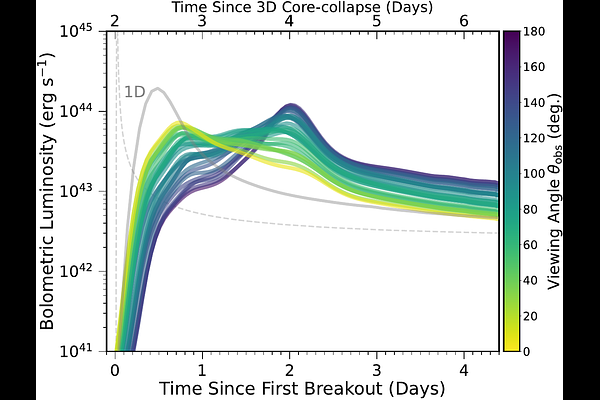
AbstractShock breakout is the first electromagnetic signal of a supernova, generating a highly luminous and fast-timescale burst of thermal radiation. Motivated by recent theoretical progress in producing successful three-dimensional supernova explosions of massive stars, we undertake a detailed numerical study on the impact that the core-collapse asymmetries might have on the breakout signal. We perform the first fully 3D multi-group radiation hydrodynamics simulations of shock breakout for the case of a red supergiant explosion. We find that large-scale asymmetries formed during the core-collapse process can extend the breakout flash duration to days, with the timescale set by the supernova shock fully wrapping around the progenitor star. Using detailed 3D radiative transfer post-processing, we generate synthetic multi-wavelength light curves and spectra to more closely connect to observations. The light curves show a significant viewing-angle dependence of the overall shape and peak brightness of shock breakout. We find that core-collapse asymmetries have the largest impact on the breakout light curve when observed in shorter UV wavelengths. On the other hand, at optical wavelengths, we find a diminished impact of the asymmetric breakout that more closely resembles a 1D spherical breakout. Our results show how multi-dimensional effects originating from the core-collapse mechanism can play a major role in setting the shock breakout properties, and are particularly relevant to upcoming UV space missions such as ULTRASAT and UVEX.