Charge Imbalance Drives Salt-Optimized Nucleosome Phase Separation under Physiological Conditions

Charge Imbalance Drives Salt-Optimized Nucleosome Phase Separation under Physiological Conditions
Silvernail, I.; Zhang, Y.; Chen, X.; Lin, X.
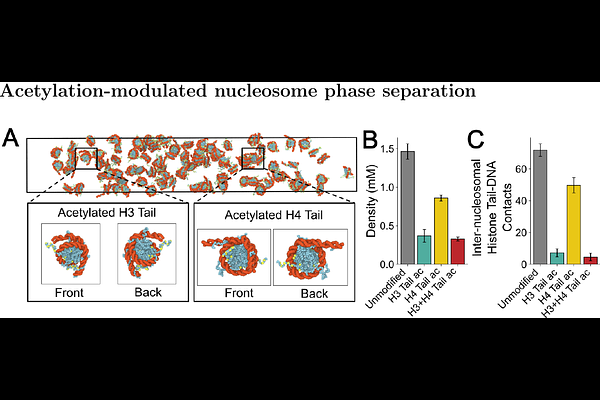
AbstractLiquid-liquid phase separation (LLPS) of chromatin contributes to genome organization and regulates genome accessibility to control gene expression. Despite advances in identifying the environmental conditions that promote chromatin condensation, the specific molecular interactions that initiate condensate formation, as well as the physical mechanisms by which DNA mechanics and epigenetic modifications modulate the resulting interaction network, remain unclear. Here, we utilize a residue-resolution, coarse-grained protein-DNA model to simulate nucleosome interactions across diverse ionic and structural conditions. Our simulations reveal non-monotonic salt-dependent phase-separation behavior, with optimal nucleosome condensation occurring under physiological salt conditions. Such a behavior was caused by the charge-imbalanced polyampholytic nature of nucleosomes, which drives competition between local protein-DNA attractions and global DNA-DNA repulsion. We further demonstrate that the conformational flexibility of nucleosomal DNA promotes unwrapping of DNA from the histone core, thereby strengthening histone-DNA interactions and enhancing condensate formation. Finally, we show that acetylation of histone H3 and H4 tails significantly reduces inter-nucleosomal interactions and increases nucleosome dynamics within condensates. Together, our study establishes a quantitative link between microscopic molecular interactions and macroscopic material properties, providing new insights into how mechanical constraints and epigenetic modifications could cooperatively tune genome architecture.