Near-identical photons from distant quantum dot-cavity devices

Near-identical photons from distant quantum dot-cavity devices
Thibaut Pollet, Victor Guilloux, Duc-Duy Tran, Anton Pishchagin, Stephen Wein, Joseph A. Sulpizio, William Hease, Petr Stepanov, Petr Steindl, Nico Margaria, Samuel Mister, Martina Morassi, Aristide Lemaître, Thi Huong Au, Sébastien Boissier, Pascale Senellart
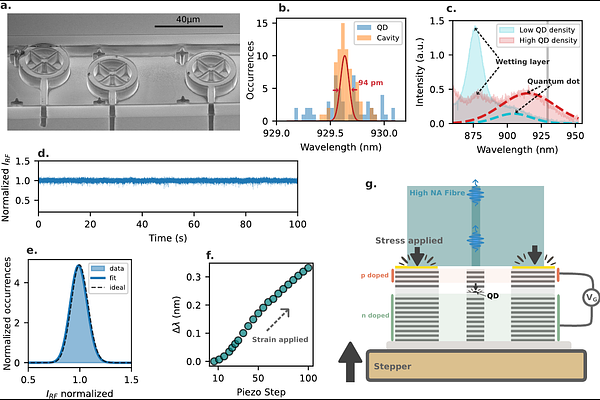
AbstractScalable optical quantum technologies require interference between large numbers of indistinguishable single-photons emitted by independent sources. Semiconductor quantum dots are known to be excellent on-demand sources of single-photons. They show record efficiency when inserted into optical cavities to control their spontaneous emission and generate trains of near identical photons over microsecond timescales. However, generating perfectly identical photons from distant cavity-based sources has remained a long-standing challenge. It requires precise matching of the emission wavelengths and emission dynamics, while simultaneously minimizing spectral noise across all time scales for distant emitters in uncorrelated environments. Here, we report on the nanofabrication of a large number of quantum dot-cavity sources with ultra-low spectral noise and wavelength dispersion. The high source efficiency and the use of two tuning mechanisms enable precise optimization of the spectral overlap between distant sources. With this approach, we demonstrate a two-photon indistinguishability of $88\pm1$ % between photons emitted from two distant sources. Remarkably, this value reaches the upper bound set by the intrinsic indistinguishability of photons emitted successively by each source. These results represent a key milestone for scaling photon-based quantum technologies.