Mediterranean dispersal imposed bottlenecks in Neolithic sheep and goats

Mediterranean dispersal imposed bottlenecks in Neolithic sheep and goats
Halpin, A.; Erven, J. A.; Alcantra, R.; Rossi, C.; Hare, A. J.; Mattiangeli, V.; Stoddart, S.; Wilczynski, J.; LLoret, A. B.; Huerta, R. P.; Perez, A. P.; Galter, J. T.; Batlle, X. T.; Sana-Segui, M.; Bradley, D. G.; Daly, K. G.
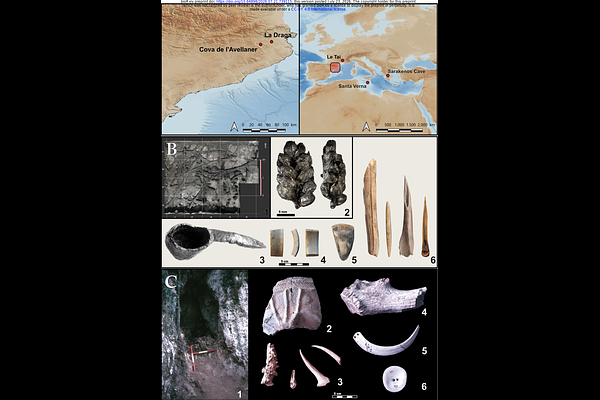
AbstractThe Neolithic period in western Eurasia involved major dispersal events, including the translocation of livestock into Europe. These domestic animal translocations likely featured founder effects, fundamentally reshaping their genetic landscape. One well-known example is the Mediterranean dispersal, hypothesised to involve rapid maritime translocation with small founding herds, yet the genetic consequences for the livestock themselves remain poorly understood. To investigate this we generated 12 palaeogenomes of sheep and goat from La Draga and Cova de l'Avellaner, and coanalyzed these with other Neolithic Mediterranean assemblages, including 4 additional novel genomes. We observe a significantly lower genetic diversity and higher runs of homozygosity (ROH) in Iberian sheep and goat populations compared to other ancient European and southwest Asian populations. We quantify the magnitude of the bottleneck in goats at ~205 Ne, highlighting the severity of the founder event. We further identify species-specific demographic trajectories: goats experienced a severe and prolonged bottleneck, likely driven by regional isolation within the western Mediterranean, intensive exploitation strategies, and small initial founding herds, while sheep were likely more frequently exchanged across the region. Lastly, identity-by-descent (IBD) indicates connectivity along the Mediterranean coast compatible with a cabotage model. This suggests that seaways facilitated rapid initial dispersal but not sustained livestock transfer from southwest Asia, shaping the genetic foundation of Iberian livestock herds.