X-ray Doppler tomography of Fe K$α$ emission in a low-mass X-ray binary 4U 1822-371 - a localized reflector at the accretion stream-disk overflow

X-ray Doppler tomography of Fe K$α$ emission in a low-mass X-ray binary 4U 1822-371 - a localized reflector at the accretion stream-disk overflow
N. Sameshima, M. Tsujimoto, M. Uemura
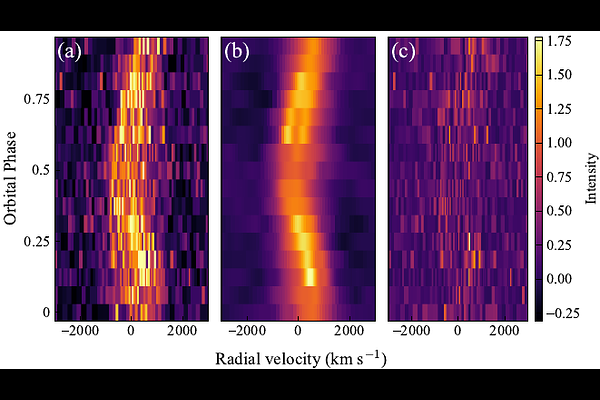
AbstractWe present the X-ray Doppler tomography of the Fe K$α$ (6.4 keV) fluorescence line of the low-mass X-ray binary 4U 1822-371 obtained with XRISM. Eleven orbits of this short period (5.57 hr) binary were covered. The Doppler shift of the line shows clear modulation with the orbital period, motivating us to apply the Doppler tomography in the X-ray band for the first time. The resulting velocity map reveals a compact feature at ($v_{\mathrm{x}}$, $v_{\mathrm{y}}$) $\sim$ ($-$550, $+$125) km s$^{-1}$. This is inconsistent with the emission originating from a symmetric accretion disk, an extended corona around the neutron star, or the surface of the neutron or companion star. Instead, it suggests that the emission originates from the accretion stream-disk overflow. Remarkably, the Fe K$α$ velocity map closely resembles that of the O VI 3811 Å, indicating that both X-ray and optical lines arise from the same site irradiated by the central X-ray source. These results provide the first velocity-resolved X-ray map of the fluorescent line, directly localizing the major reflector in an X-ray binary and establishing X-ray Doppler tomography as a new probe of the structures of accreting systems.