A co-expression strategy allows effective protein-protein binding affinities to be assessed as a function of concentration within live cells

A co-expression strategy allows effective protein-protein binding affinities to be assessed as a function of concentration within live cells
Stam, S.
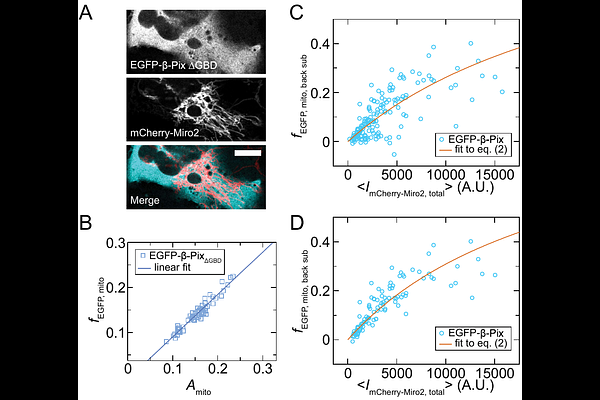
AbstractWeak, transient molecular interactions are ubiquitous amongst biological molecules. Regulatability by intracellular concentrations, localization, and other factors is central to their importance. Here, we measure co-localization between fluorescently labeled proteins, Miro2 and {beta}-Pix, to assess their effective binding affinity and its dependence on protein concentration. Co-localization between the two is quantifiable due to the mitochondrial localization of Miro2, which allows the otherwise cytosolic {beta}-Pix to be drawn to mitochondria. Determining the fraction of overexpressed {beta}-Pix co-localizing with mitochondria as a function of overexpressed Miro2 levels allows calculation of an effective dissociation constant from a mass-action binding model. Both the fit to the model and the effective dissociation constant for Miro2 and {beta}-Pix binding depend on the concentration of {beta}-Pix, which suggests that one or more model assumptions do not hold. Additional experiments reveal that competitive binding and/or {beta}-Pix sequestration by Git1 are possible explanations for the {beta}-Pix concentration dependence. Our modeling strategy is readily extendable to ectopic localization of proteins to mitochondria and other compartments for the assessment of co-localization with a binding partner. This reveals fundamental properties of protein-protein interactions and how they may be regulated by protein concentration and other intracellular conditions.