Machine learning-guided spatial omics for tissue-scale discovery of cell-type-specific architectures

Machine learning-guided spatial omics for tissue-scale discovery of cell-type-specific architectures
Lian, Y.; Adjavon, D.; Kawase, T.; Kim, J.; Fleishman, G.; Preibisch, S.; Funke, J.; Liu, Z. J.
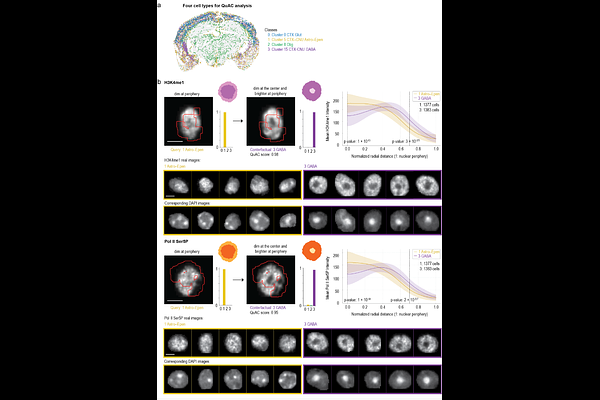
AbstractMultiplexed protein imaging enables spatially resolved analysis of molecular organization in tissues, but existing spatial proteomics platforms remain constrained in scalability, throughput, and integration with RNA measurements and interpretable computational analysis. Here, we present an integrated spatial omics framework that combines highly multiplexed protein and RNA imaging with explainable machine learning to map cell-type-specific molecular and structural architectures at tissue scale. Using this platform, we simultaneously profiled up to 46 proteins and 79 RNA species across ~370,000 cells in intact mouse brain tissue at diffraction-limited subcellular resolution (~260 nm). We developed a scalable, open-source computational pipeline for large-scale image processing and analysis, and show that nuclear protein and chromatin features alone are sufficient to accurately classify brain cell types and their spatial organization. Incorporation of explainable deep learning further enabled identification of human-interpretable, cell-type-specific subnuclear structural features directly from imaging data, with independent quantitative validation. Together, this integrated experimental and computational framework enables tissue-scale spatial proteomics-based cell-type classification and structural feature discovery, providing a broadly applicable platform for mechanistic studies, high-content screening, and translational applications.