Potent substoichiometric inhibition of alpha-synuclein aggregation by de novo oligomer-binding proteins

Potent substoichiometric inhibition of alpha-synuclein aggregation by de novo oligomer-binding proteins
Zhang, Y.; Han, H. L.; Ortigosa-Pascual, L.; Miles, U. Z.; Snow, F.; Tu, D.; Meisl, G.; Nott, T. J.; Laman, H.; McShan, A. C.; Sahtoe, D. D.; Knowles, T. P. J.
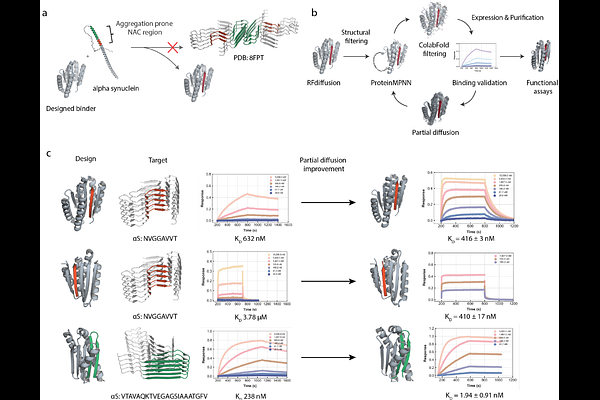
AbstractThe non-amyloid {beta} component (NAC) domain of alpha synuclein (Syn) drives Syn aggregation in Parkinson disease, yet as an intrinsically disordered segment it lacks a stable epitope for conventional ligand discovery. Using deep learning-based protein design, we generated compact single-chain binders that take advantage of the propensity of the NAC domain to adopt an extended {beta}-strand conformation, which they engage and stabilise. From 21 expressed designs, 3 engaged the target both in vitro and within live cells. A single round of partial diffusion improved their affinity, maturing the strongest binder to a dissociation constant of 1.94 nM with no detectable cross-reactivity to tau, amylin or amyloid {beta}. Solution NMR spectroscopy confirmed Syn peptide association with all three binders and showed that peptide binding induces conformational changes consistent with the intended design architecture. Each binder engaged a distinct point on the aggregation pathway. Kinetic analysis combining seeded aggregation with the measured affinities for monomer, oligomer and fibril resolved the specific microscopic step that each binder inhibits. Notably, the most potent binder acted by selectively capturing on-pathway oligomers, the species most closely linked to toxicity, and suppressed fibril formation at substoichiometric ratios without engaging the bulk monomer. Together, these findings establish de novo-designed Syn binders that selectively target distinct aggregation intermediates to mechanistically reshape Syn assembly, providing a framework for the rational design of aggregation-modifying proteins.