Correlated decoding loses the surface code's effective distance below threshold

Correlated decoding loses the surface code's effective distance below threshold
César Hernando de la Fuente, Joonas Majaniemi, Evert van Nieuwenburg, Felix Frohnert
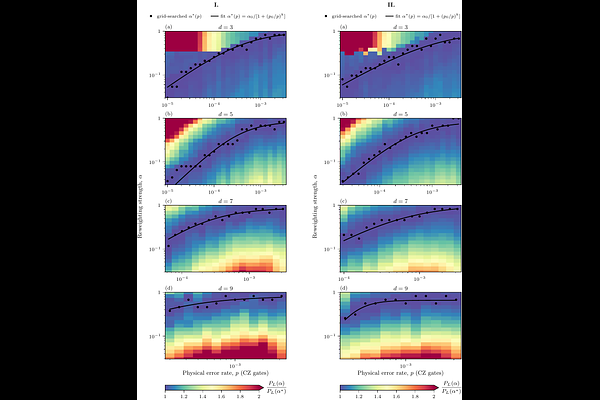
AbstractCorrelated decoding improves matching and clustering surface-code decoders by reweighting one decoding subgraph conditioned on the other's correction. We show that standard reweighting can cause correlated decoders to fail on size-$(d-1)/2$ fault configurations that a distance-$d$ code should correct, reducing error suppression deep below threshold. Under circuit-level noise, a single first-pass edge can discount several correlated edges, even though their joint occurrence requires additional independent faults, so the decoder favors an over-discounted correction. Regularizing the reweighting rule restores the nominal distance scaling and a clear correlated-decoding advantage.