Italia: A PARP-Directed Auger Electron-Emitting Agent for Targeted Radionuclide Therapy of Cancer

Italia: A PARP-Directed Auger Electron-Emitting Agent for Targeted Radionuclide Therapy of Cancer
Unnikrishnan, S.; Rua, C.; Li, G.; Delgado Mayenco, N.; Hernandez Cano, L.; Bozan, G.; Patmanidis, I.; Simwaka, S.; Kurniawan, A.; Szymanski, W.; de Vries, E. F. J.; Elsinga, P. H.; Farinha Antunes, I.; Destro, G.; Cornelissen, B. T.
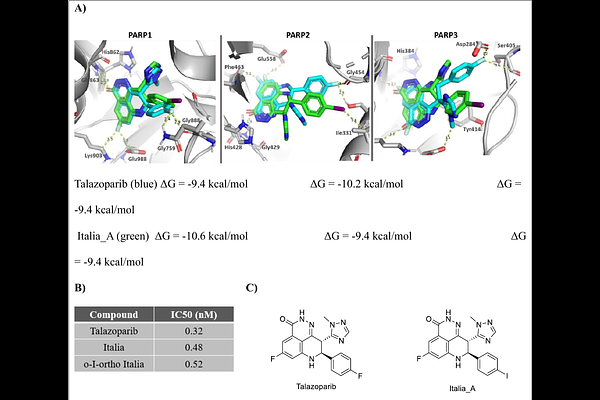
AbstractPoly(ADP-ribose) polymerase 1 (PARP1) is a central mediator of DNA damage repair and an established therapeutic target in homologous recombination-deficient cancers. Radiolabelled PARP inhibitors provide a strategy to deliver cytotoxic radiation directly to tumour DNA by exploiting PARP overexpression and trapping at sites of DNA damage. Here, we describe the design, radiosynthesis, and in vitro evaluation of [123I]Italia, a talazoparib-derived Auger electron-emitting agent for PARP-targeted radionuclide therapy. Stereochemically pure [123I]Italia, (8S,9R)-5-fluoro-8-(4-(iodo-123I)phenyl)-9-(1-methyl-1H-1,2,4-triazol-5-yl)-2,7,8,9-tetrahydro-3H-pyrido[4,3,2-de]phthalazin-3-one was synthesised in one step via copper-mediated iodo-deboronation, achieving activity yields >80% and molar activities >6.2+-3.1 GBq/umol (n=8). UPLC analysis confirmed radiochemical purity >97%. Italia exhibited potent PARP1 inhibition (IC50 0.48 nM) and in silico predicted binding affinity comparable to talazoparib. In a panel of PARP-expressing cancer cell lines, [123I]Italia demonstrated highest uptake at 60 min, PARP-selective uptake, predominant nuclear localisation (up to 60% of added activity) and chromatin association consistent with PARP trapping (up to 15% of total activity recorded). Uptake was reduced more than 50-fold by addition of an excess of any PARP inhibitor (e.g. olaparib, talazoparib, and rucaparib) and in PARP1 knockout cells, confirming target specificity. Clonogenic assays showed a marked, added activity-dependent reduction in survival of PARP-expressing cells following a brief one-hour exposure, whereas PARP1-deficient cells were resistant. Collectively, these findings identify [123I]Italia as a promising PARP-targeted Auger electron-emitting theranostic candidate that warrants further in vivo evaluation.