Fermi-LAT View on Three Ultra-high-energy 1LHAASO Sources in the $52^{\circ}<l<55^{\circ}$ Region

Fermi-LAT View on Three Ultra-high-energy 1LHAASO Sources in the $52^{\circ}<l<55^{\circ}$ Region
Linjie Liu, Xian Hou, Pierrick Martin, Chuyuan Yang
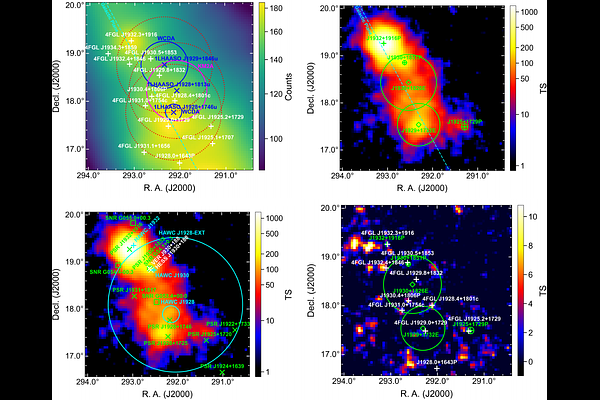
AbstractUsing more than 17 yr of Fermi-LAT data, we performed a detailed investigation of the complex $52^{\circ}<l<55^{\circ}$ region, which encompasses the three ultra-high-energy sources 1LHAASO J1928+1746u, 1LHAASO J1928+1813u, and 1LHAASO J1929+1846u.This region hosts multiple SNRs, pulsars, GeV and TeV sources. Our analysis resolves the GeV emission into three pointlike sources (J1925+1729P, J1930+1851P, and J1932+1916P) and two extended sources (J1929+1732E and J1930+1826E), and improves significantly on the description based on the 4FGL-DR4 catalog. Source J1932+1916P is identified as the known gamma-ray pulsar PSR J1932+1916, while J1925+1729P may be a new gamma-ray pulsar candidate distinct from the known gamma-ray pulsar PSR J1925+1720. This warrants future investigation and a search for pulsations. Source J1930+1851P coincides with the TeV source PWN/SNR G54.1+0.3 and its GeV-TeV spectrum is consistent with both leptonic and hadronic interpretations, although a leptonic origin in relation to the known PWN is more likely. The GeV-TeV spectrum of J1929+1732E is consistent with a hybrid lepto-hadronic scenario in which the TeV emission traces the PWN powered by the pulsar PSR J1928+1746, while the GeV emission may result from interactions between particles escaped from the parent SNR and illuminating the gas environment. Similarly, J1930+1826E is likely connected to PWN/SNR G54.1+0.3 under a hadronic scenario involving escaped particles in their early propagation stage. Owing to spectral and/or morphological mismatches, the connection of these five GeV sources to the three LHAASO sources is not clear. This warrants deeper observations with HAWC and LHAASO, and a dedicated study of the modeling of the Galactic diffuse emission. Future CTAO observations with higher angular resolution are expected to deliver crucial information for the study of this region.