Optogenetic decoupling of ODC inhibition and degradation reveals a requirement of polyamine oscillation for cell cycle progression

Optogenetic decoupling of ODC inhibition and degradation reveals a requirement of polyamine oscillation for cell cycle progression
Zhang, Z.; Wu, B.; Wu, K.; Chen, Z.; Liu, S.
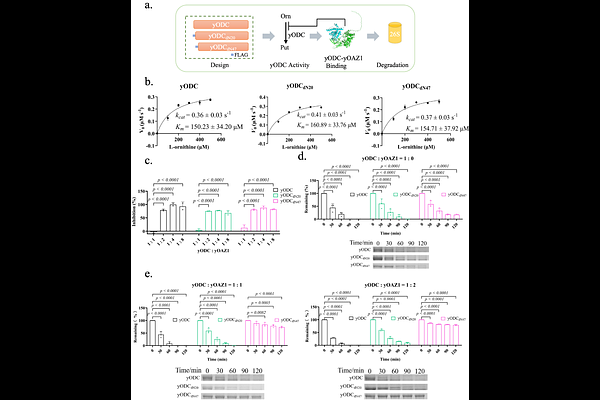
AbstractThe dysregulation of polyamine homeostasis is a fundamental hallmark of both cancer and aging. Ornithine decarboxylase (ODC), the rate-limiting enzyme in polyamine synthesis, is regulated by the antizyme OAZ1 through a dual mechanism: inhibition of enzymatic activity and induction of proteasomal degradation via a C-terminal degron. In Bachmann-Bupp syndrome (BABS), mutations in this degron lead to ODC accumulation and toxic polyamine levels. However, the functional coupling between ODC inhibition and degradation remains poorly understood, and the current therapeutic intervention with DFMO target enzymatic activity without addressing protein accumulation. Here, we developed an optogenetic yeast model of BABS to decouple ODC inhibition from its degradation. By fusing a light-switchable LOV2-based module to a truncated, degron-less yeast ODC, we created a system where ODC degradation is controlled by light, independent of OAZ1 binding. We demonstrate that the loss of the ODC degron mimics the BABS cellular phenotype, characterized by increased polyamines, elevated ROS, and growth arrest. Crucially, while constant light-induced degradation is insufficient to rescue growth, oscillating ODC degradation at a 40-minute period restores polyamine homeostasis, cell cycle progression, and cellular growth. Our findings demonstrate that the inhibitory and degradation-inducing roles of OAZ1 can be decoupled and highlight the necessity of periodic polyamine oscillation for the cell cycle. Our work would be of great value for understanding the regulation mechanism of the polyamine metabolic network and establishing new targeted therapeutic strategies.