Heavy element dust explains the late-time spectra of kilonovae

Heavy element dust explains the late-time spectra of kilonovae
Nanae Domoto, Kenta Hotokezaka, Daniel Kasen
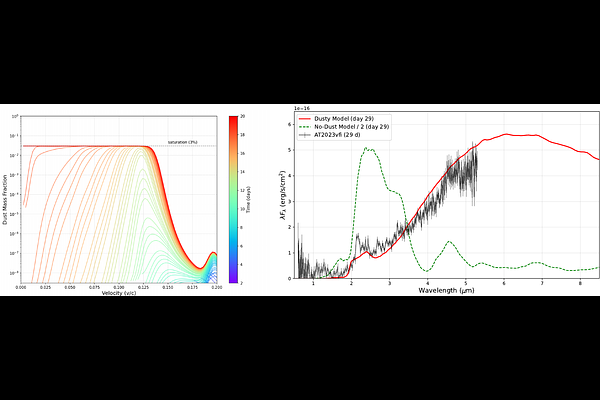
AbstractNeutron star mergers are a leading site of $r$-process, producing radioactively powered optical and infrared transients known as kilonovae. Observations of the kilonovae AT2017gfo, associated with the gravitational-wave event GW170817, and AT2023vfi, associated with GRB 230307A, have enabled measurements of the mass of ejected $r$-process material and the identification of heavy elements in the ejecta. However, late-time observations reveal strong infrared emission with temperature below 1000 K, which is difficult to explain by atomic absorption and emission processes alone. In this paper, we show that kilonova ejecta provide conditions favorable for the formation of dust grains composed of refractory $r$-process elements including Zr, W, and Os. We calculate the kinetic formation of dust grains using reaction rate coefficients of W as a proxy, finding that dust forms efficiently, particularly in slow ejecta. This stands in contrast to a previous study that relied on a classical nucleation framework. By performing radiative transfer simulations that incorporate dust formation, we demonstrate that $r$-process dust naturally explains the observed late-time infrared emission. The formation and abundance of $r$-process dust are highly sensitive to the ejecta mass, composition, and expansion velocity. Infrared emission from $r$-process dust can therefore serve a new probe of heavy-element production in neutron star mergers.