Structural Landscape of MHC Complexes through Fold Mining

Structural Landscape of MHC Complexes through Fold Mining
de Lima, G. S.; dos Santos, P. H. A.; de Assis, S. C.; Nazare, P. G. B. d. S.; Simoes, C. D. M. S.; Chaves, E. J. F.; Jara, G. E.; Maidana, R. L. B. R.; Ribeiro-Filho, H. V.
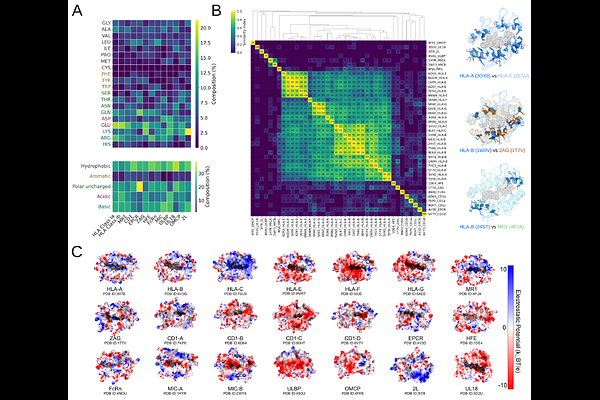
AbstractMajor histocompatibility complex (MHC) proteins share a characteristic structural platform formed by two -helices positioned above a {beta}-sheet (1-2 domain), which can accommodate ligands and provide an exposed surface for recognition by protein binding partners. This interaction system is best characterized for classical MHC-I molecules presenting peptides to T-cell receptors (TCRs), one of the most extensively studied mechanisms of immune recognition. However, non-classical MHC and MHC-like proteins reveal that the 1-2 platform is considerably more versatile, supporting a remarkably diverse range of biological functions. Related architectures are also exploited by pathogens, further expanding the diversity of molecular interactions associated with this fold. Yet how this functional diversity relates to structural variation within the shared 1-2 platform and to the diverse modes of recognition employed by natural and engineered binding partners has not been systematically examined across the broader MHC fold. Here, we systematically mapped MHC 1-2-like domains across experimentally determined structures in the Protein Data Bank and predicted structures in the AlphaFold Protein Structure Database using Foldseek, and compiled their natural and engineered binding partners. Our comparative analyses revealed substantial heterogeneity across multiple structural layers, including 1-2 geometry, ligand-binding cavity architecture, and the physicochemical properties and spatial conservation of exposed recognition surfaces, despite the overall conservation of the fold. We further characterized a diverse repertoire of natural and engineered binding partners, revealing distinct structural architectures, interface compositions, and recognition geometries. Together, these findings provide an integrated structural landscape connecting the diversity of the MHC fold with the multiple modes of molecular recognition it supports, offering a comparative framework for understanding these interactions and guiding the engineering of novel MHC-targeting proteins.