pHaseMD4AI: Phase-Space Dynamics Dataset with Chemical and pH Perturbations for Physically and Kinetically Consistent Biomolecular AI

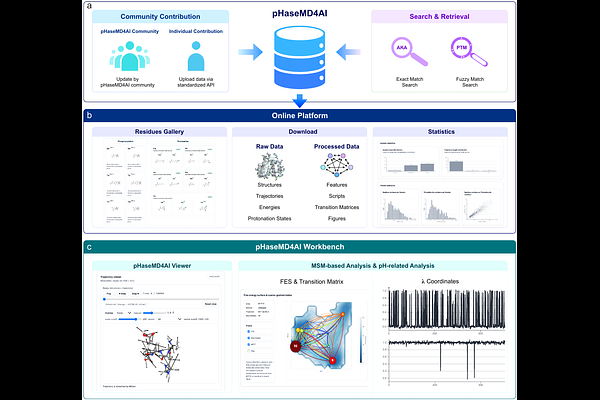
pHaseMD4AI: Phase-Space Dynamics Dataset with Chemical and pH Perturbations for Physically and Kinetically Consistent Biomolecular AI
Song, T.; Guo, Y.; He, J.; Liu, Z.; Low, M.; Wang, K.; Zhang, Y.; Li, Z.; Huang, Y.; Wang, Y.
AbstractProtein function emerges from dynamic conformational ensembles and transitions that are challenging to characterize experimentally and computationally. Recent advances in generative AI have created new opportunities for learning molecular thermodynamics, kinetics, and conformational evolution directly from simulation data, but progress is limited by the availability of large-scale datasets that combine rigorous sampling, complete phase-space information, and diverse physicochemical perturbations. Here, we present pHaseMD4AI, a molecular dynamics dataset that combines a globally equilibrated peptide branch with a protein-scale constant-pH molecular dynamics (CpHMD) branch spanning hundreds of soluble proteins. The peptide branch includes a complete set of canonical tripeptide and tetrapeptide systems together with post-translationally modified (PTM) and protonation-state datasets, providing synchronized atomic coordinates (R), velocities (V), forces (F), and Markov state model-based kinetic annotations. An accompanying web portal (https://isb.zju.edu.cn/md4ai/) enables users to browse, visualize, and download trajectories, annotations, and metadata. As an example application, we demonstrate a sequence-based model that can predict residue-level equilibrium dihedral distributions from sequence. pHaseMD4AI provides a resource for developing and benchmarking molecular machine learning methods while supporting broader studies of biomolecular dynamics under sequence, post-translational modification, and protonation-state perturbations.