Circulating extracellular vesicles in plasma carry accessible molecular signatures of aging in mice

Circulating extracellular vesicles in plasma carry accessible molecular signatures of aging in mice
Tsantilas, K. A.; Riffle, M.; Merrihew, G. E.; Wu, C. C.; Keele, G. R.; Maurais, A.; Johnson, R. S.; Luciano, A.; Robinson, L.; Churchill, G. A.; MacCoss, M. J.
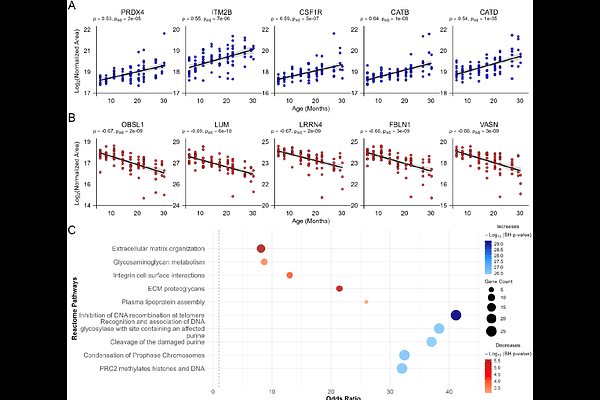
AbstractCells release membrane-bound extracellular vesicles into the bloodstream laden with proteins that may reflect their physiological state. How this circulating EV proteome changes across life remains poorly understood. Identifying molecular signatures of aging in accessible biofluids could facilitate earlier intervention and monitoring of age-related disease. Many circulating aging proteome studies rely on affinity-based platforms which suffer from poor cross-species translation, ambiguous signal attribution, and inconsistent agreement between platforms. Here, we present a characterization of the aging plasma EV proteome from a cross-sectional cohort of 86 male and female C57BL/6J mice (5-31 months). We leveraged a species-agnostic EV enrichment (Mag-Net) and mass spectrometry to detect 2,575 protein groups from 15,969 peptides. Protein abundance heterogeneity increased with age and the abundance of 272 proteins were significantly correlated with chronological age including established senescence and frailty markers. Proteins increasing with age were enriched in genome maintenance pathways, while those decreasing were associated with the extracellular matrix organization and lipid metabolism. Notably, several of the strongest age-increased proteins converged on Alzheimer's and Parkinson's disease pathology. We observed sexual divergence in the aging EV proteome not previously characterized at this resolution. A proteomic clock built from this data accurately predicts chronological age, and peptide-level analysis reveals aging signals invisible at protein-level. These findings demonstrate that EV-enriched plasma proteomics can identify known aging markers, reveal novel sex-specific age-related changes, and generate predictive models of chronological age. This study provides a species-agnostic foundation for proteomic clocks that complement epigenetic approaches to monitor aging and evaluate healthspan.