Measuring magnetic field effects in fluorescent flavoproteins via spin-dependent fluorescence intensity requires photoexcitation to be faster than spin-independent ground state recovery

Measuring magnetic field effects in fluorescent flavoproteins via spin-dependent fluorescence intensity requires photoexcitation to be faster than spin-independent ground state recovery
Ross, B. L.; Lodesani, A.; Aiello, C. D.
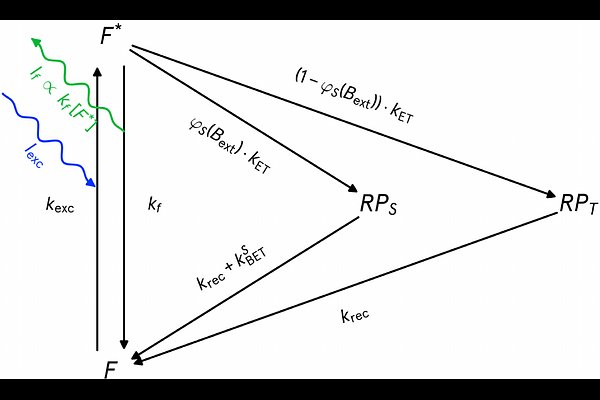
AbstractWeak magnetic fields affect many biological processes across the tree of life, though the precise molecular sensors and pathways involved in such magnetoresponses remain mostly uncharacterized. Fluorescence is a useful tool for investigating magnetic field effects in flavoproteins, as their chromophore's fluorescence intensity can be shown to depend on the spin states of electronic radical pairs. Here, we describe a four-state ordinary differential equation model to understand what parameter sets result in fluorescence contrast between spin states in photocycles with singlet and triplet radical pairs. We conclude that only certain sets of parameters result in the fluorescence intensity being a good proxy measurement for singlet yield. In particular, we observe that the illumination intensity required to obtain fluorescence contrast depends on the rate of the slow spin independent radical termination reactions that recover ground-state oxidized fluorophores. Moreover, to observe a magnetic field effect in fluorescence intensity when an external magnetic field modulates the singlet yield, the illumination intensity must be strong enough such that photoexcitation is not the rate-limiting step. This understanding suggests that flavoproteins that do not exhibit magnetic field effects in their fluorescence emission under certain experimental setups may still be sensitive to weak magnetic fields in terms of function, as magnetosensitivity in fluorescence depends strongly on illumination conditions.