Detection of a parsec-scale, compact, and fading ejecta from an accreting massive black hole

Detection of a parsec-scale, compact, and fading ejecta from an accreting massive black hole
Chao Li, Ning Chang, Jun Yang, Lang Cui, Luis C. Ho
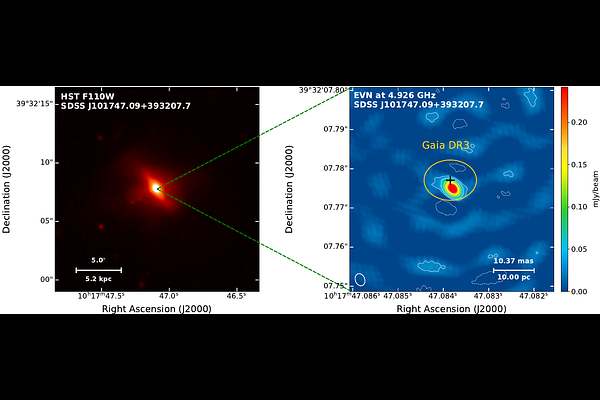
AbstractDwarf galaxies, characterized by their low luminosities and masses, are excellent candidates for searches for intermediate-mass black holes (IMBHs), particularly when they show strong accretion and ejection activity. The dwarf galaxy SDSS J101747.09+393207.7 has recently been found to display a very high X-ray luminosity and an X-shaped optical structure, possibly caused by a dwarf--dwarf merger. To explore its potential IMBH ejection activity, we performed very long baseline interferometry (VLBI) observations at 4.9 GHz. In this work, we present the detection of a milliarcsecond-scale, compact, sub-microjansky radio component near the optical centroid. According to some existing radio sky survey data, the radio component was not detected until 2015; it displayed an optically thin steep radio spectrum and declining flux densities across 0.8--5 GHz from 2019 to 2025. Therefore, we identify it as a short-lived and rarely seen ejecta that was produced by unstable accretion onto a massive black hole and likely faded away in a few decades. These results indicate that short-lived, episodic jet activity from accreting IMBHs in dwarf galaxies might exist.