Stress-Induced Mechanical Memory in Respiratory Mucus: Anisotropy, Network Reorganization, and Directional Transport

Stress-Induced Mechanical Memory in Respiratory Mucus: Anisotropy, Network Reorganization, and Directional Transport
Prabhune, A. G.; Rezaei, B.; Garcia-Gordillo, A. S.; Das, M.; Vernerey, F. J.; Figueroa-Morales, N.
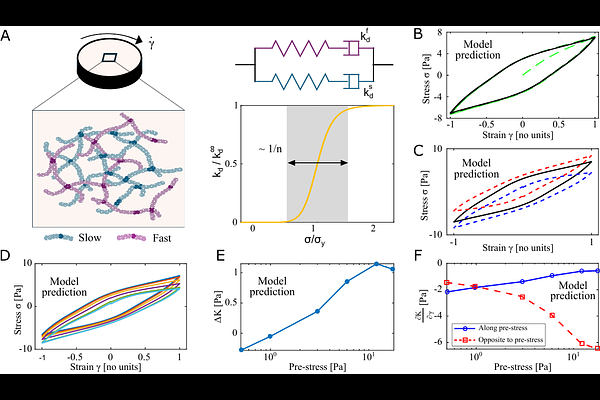
AbstractMucus transport is essential for lung health, as ciliated cells constantly propel mucus outward to clear bacteria, viruses, and particles. This defense relies on a material that must be elastic enough to maintain ciliary traction, but capable of reorganizing under sustained directional loading. How the mucin network reconciles these demands, and whether it retains a memory of the stresses it experiences, remains poorly understood. Here we show that lung mucus develops a persistent, direction-dependent mechanical asymmetry under physiologically relevant stress--a mechanical memory encoded in the slow scaffold of the network. Using bulk rheology, we find that directional pre-stress produces a residual anisotropy that grows with stress magnitude and persists long after the load is removed. A transient network model attributes this memory to a separation of timescales between transient bonds and a long-lived crosslink scaffold, and particle-tracking microrheology confirms that the memory reorganizes the network geometry at the scale of biological particles, biasing tracer diffusion along the axis of applied stress. The stresses required to induce memory are within the range generated by ciliary beating and remain below the mucus yield threshold, suggesting that mucociliary clearance operates in a regime where directional alignment accumulates without compromising the coherence of the mucus layer. This proximity to yield may not be coincidental, it allows mucus to accumulate mechanical memory under physiological forcing while remaining poised to flow during clearance events such as coughing.