Genetic architecture of soluble arabinoxylan fibre in elite genotypes of bread wheat revealed by genome-wide association analysis

Genetic architecture of soluble arabinoxylan fibre in elite genotypes of bread wheat revealed by genome-wide association analysis
Alabdullah, A. K.; Kosik, O.; Leverington-Waite, M.; Mitchell, R. A.; Prins, A.; Brett, J.; Griffths, S.; Shewry, P. R.; Lovegrove, A.
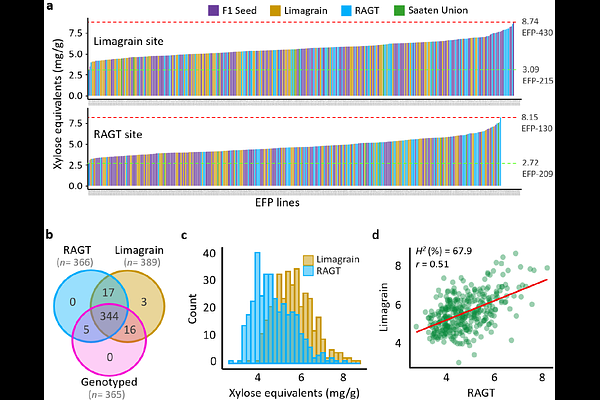
AbstractDietary fibre intake remains below recommended levels, and increasing fibre content of widely consumed white wheat flour (derived from the starchy endosperm) represents a scalable strategy to improve public health. In wheat starchy endosperm, arabinoxylan (AX) is the dominant fibre component, with the water-extractable (WE) fraction being particularly beneficial to health. We assembled an Elite Fibre Panel (EFP) of 384 elite modern wheat genotypes from UK commercial breeding programmes and quantified the content of WE-AX in wholemeal, as a proxy for soluble AX in white flour, across two UK field environments. Wholemeal WE-AX, showed substantial quantitative variation and moderate genotype-by-environment interaction, with a broad-sense heritability of 0.68. Genome-wide association analyses using 6,791 SNPs identified seven loci associated with WE-AX content. The strongest and most stable effects were mapped to major loci on chromosomes 1B and 6B, previously implicated in AX regulation, while additional loci of smaller and sometimes environment-dependent effect were detected on chromosomes 3A, 5B, and 7A. Favourable alleles increased WE-AX content by ~5-15% and combined additively. LD-defined intervals contained several high-confidence candidate genes involved in cell-wall biosynthesis, remodelling and post-depositional modification, including PER1, a validated regulator of arabinoxylan cross-linking, together with genes encoding a UTP-glucose-1-phosphate uridylyltransferase, trichome birefringence-like proteins and xyloglucan endotransglucosylase/hydrolases. These findings demonstrate that substantial gains in soluble AX can be achieved by pyramiding favourable alleles already segregating within elite germplasm, providing a practical route for breeding wheat with enhanced dietary fibre content and improved nutritional quality.