Integrative computational toxicology reveals PFOS and PFHxS associated inflammatory keratinocyte niches in psoriasis through exposure transcriptomics, single-cell spatial mapping and token-aware virtual perturbation

Integrative computational toxicology reveals PFOS and PFHxS associated inflammatory keratinocyte niches in psoriasis through exposure transcriptomics, single-cell spatial mapping and token-aware virtual perturbation
Ma, J.; Yu, Q.
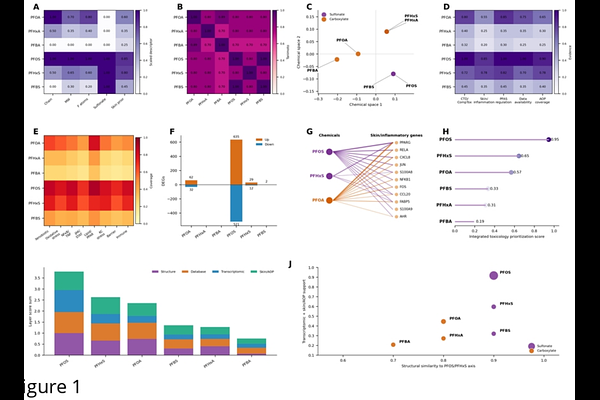
AbstractPer- and polyfluoroalkyl substances (PFAS) are persistent toxicants with immunological, metabolic and epithelial effects, but their relevance to inflammatory skin disease remains unclear. We developed a computational toxicology framework to test whether perfluoroalkyl sulfonate programs, especially perfluorooctanesulfonic acid (PFOS) and perfluorohexanesulfonic acid (PFHxS), converge with psoriasis-associated keratinocyte inflammation. Exposure transcriptomes were derived from GSE236956, in which human embryonic stem cell-derived epithelial-lineage models were exposed to 10 M PFAS for 8-16 days. Six PFAS were prioritized using descriptors, Tanimoto similarity, toxicology evidence, adverse outcome pathway (AOP)-like key events, exposure differentially expressed gene burden and read-across support. PFAS signatures were integrated with psoriasis bulk transcriptomes, single-cell RNA sequencing, keratinocyte-state mapping, regulator and communication inference, spatial transcriptomics and token-aware Geneformer-compatible virtual perturbation. PFOS ranked highest in integrated prioritization, followed by PFHxS and perfluorooctanoic acid. PFHxS produced a smaller but directionally informative signature within a PFOS-dominant perfluoroalkyl sulfonate footprint. The shared PFOS and PFHxS program converged with psoriasis through inflammatory keratinocyte, epidermal-stress, cytoskeletal and lipid-related modules. Single-cell and spatial analyses localized the program to activated keratinocytes and inflammatory epidermal niches, with strong spatial co-localization with inflammatory keratinocyte and epidermal stress scores. Virtual perturbation prioritized S100A9, S100A8, KRT16, IL36G, CCL20, CXCL8, FABP5, KRT17, FOS, JUN and NFKBIZ as candidate effectors. These findings support an exposure-informed, experimentally testable hypothesis linking persistent perfluoroalkyl sulfonate programs to keratinocyte inflammatory niches in psoriasis.