Bimodal Coupling Optimization in Biological Rhythms: Balancing Energy Efficiency and Functional Demand

Bimodal Coupling Optimization in Biological Rhythms: Balancing Energy Efficiency and Functional Demand
Zhang, J.; Han, J.; Xie, L.-L.
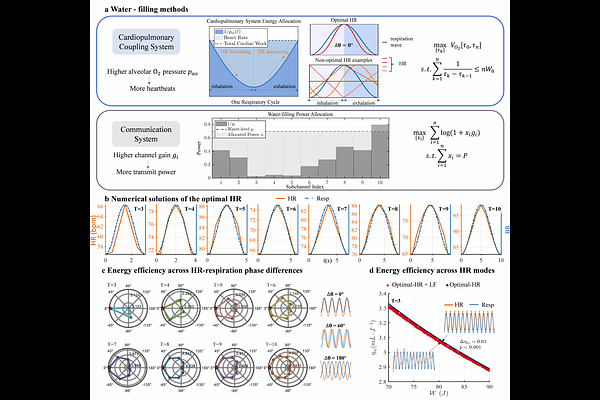
AbstractBiological rhythms are governed by intricate interactions among oscillatory subsystems, yet how they balance functional demands and energy efficiency remains unclear. We present a bimodal coupling optimization strategy where physiological systems dynamically alternate between synchronized (energy-saving) and desynchronized (function-priority) coupling modes. By employing the water-filling principle developed in communications engineering, we prove synchronized heart rate(HR)-respiration oscillations maximize energy efficiency (oxygen uptake per cardiac work). Then, system modeling confirms task/stress-induced oxygen demands enhance oxygen uptake at the cost of desynchronization and reduced efficiency. Experiments reveal a 70.36% decrease in HR-respiration synchronization during arithmetic versus relaxation, enabling 4.43% higher oxygen uptake but with 11.38% lower energy efficiency. This bimodal coupling optimization strategy is also evident in pancreatic islets, with their insulin/glucagon oscillator alternating between in-phase (energy-saving) and anti-phase (rapid glucose reduction) coupling. This framework, integrating engineering and life sciences, reveals a universal regulatory principle for biological oscillatory systems.