Eccentricity as a signature of hierarchical subsolar-mass mergers in collapsar disks

Eccentricity as a signature of hierarchical subsolar-mass mergers in collapsar disks
Jiaxi Wu, Elias R. Most, Nils L. Vu, Nils Deppe, Lawrence E. Kidder, Kyle C. Nelli, William Throwe
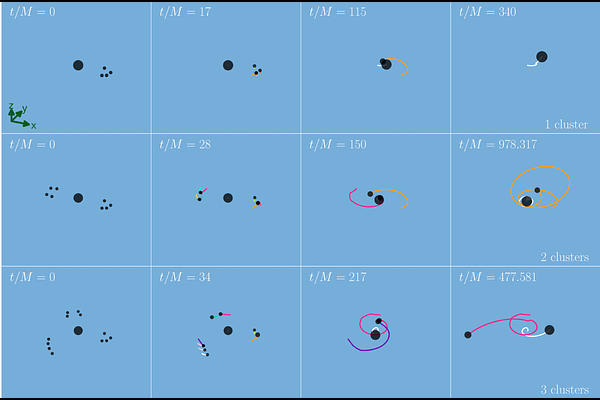
AbstractIn this work, we investigate gravitational-wave signatures of a proposed subsolar-mass merger scenario resulting from fragmentation inside a collapsar accretion disk. This scenario has gained recent interest with the electromagnetic transient AT2025ulz, a possible superkilonova counterpart candidate to the sub-threshold gravitational wave event S250818k. One prediction of fragmentation is the formation of multiple smaller neutron-star fragments, some of which might merge hierarchically. Such mergers are expected not only to produce individual electromagnetic counterparts, but also, because of their repeated capture and merger dynamics, to impart kicks to the system and thereby drive orbital eccentricity. By performing numerical relativity simulations of hierarchical compact object mergers modeled as black holes in a disk-like geometry consistent with this scenario, we demonstrate the build-up of potentially large eccentricity for the final merger, of order $e \simeq 0.6$ initially, and show that, because of the short lifetime of the system, a substantial part of this eccentricity , up to $e\simeq 0.1$, can survive until merger in the general case. As a result, future detections of eccentricities in potential subsolar-mass gravitational-wave candidate events would be a strong indicator for a hierarchical formation scenario.