Steroid-based Tide Quencher 1 probes enable real-time mapping of novel non-canonical cholesterol sites on the M1 muscarinic receptor

Steroid-based Tide Quencher 1 probes enable real-time mapping of novel non-canonical cholesterol sites on the M1 muscarinic receptor
Chetverikov, N.; Szanti-Pinter, E.; Jurica, J.; Vodolazhenko, M.; Budesinsky, M.; Zima, V.; Svoboda, M.; Dolejsi, E.; Janouskova-Randakova, A.; Urbankova, A.; Jakubik, J.; Kudova, E.
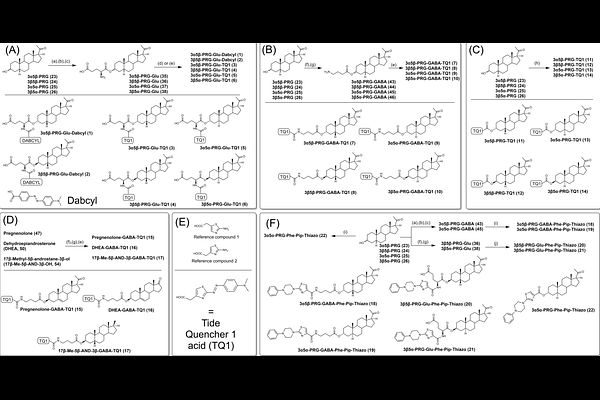
AbstractSteroid-based fluorescent-quencher probes now enable real-time, residue-level mapping of previously inaccessible cholesterol-binding sites on G-protein-coupled receptors. We designed Tide Quencher 1 (TQ1) conjugated steroids that target two distinct peripheral sites on the M1 muscarinic receptor. One near the extracellular N-terminus and another adjacent to the intracellular C-terminus. Using pregnanolone glutamate as a versatile scaffold, we synthesised a library of probes varying in C-3 linker length ({gamma}-aminobutyric acid vs. L-glutamic acid) and C-3/C-5 stereochemistry (3/3{beta}/5/5{beta}). Fluorescence-quenching assays with CFP-tagged receptors revealed that TQ1 probes consistently outperformed Dabcyl, delivering up to 40 % quenching within minutes and sub-micromolar EC values. The most potent N-terminal probe (35-PRG-Glu-TQ1 (5)) achieved 300 nM potency, while the best C-terminal probe (35{beta}-PRG-Glu-TQ1 (3)) reached 1 M potency with rapid association. Molecular docking and MD simulations identified key residues (K20, Q24, W405 at the N-site; K57, Y62, W150 at the C-site) mediating binding, a prediction confirmed by alanine-scan mutagenesis that markedly reduced quenching at the N-terminus and only modestly affected the C-terminus. Competition experiments with non-quenching analogues further validated probe specificity. Crucially, the pregnane core proved essential; alternative steroid backbones failed to generate robust quenching. This fluorescence-quenching platform overcomes the limitations of traditional radioligand assays, providing kinetic insight, high-throughput compatibility, and the ability to dissect lipid-GPCR interactions in native membranes. The approach is readily extensible to other GPCR families, opening new avenues for structure-guided drug discovery targeting allosteric cholesterol sites.