Multi-wavelength Emission Modeling from Accretion Flows around Isolated Black Holes Including Magnetic Flux Transport

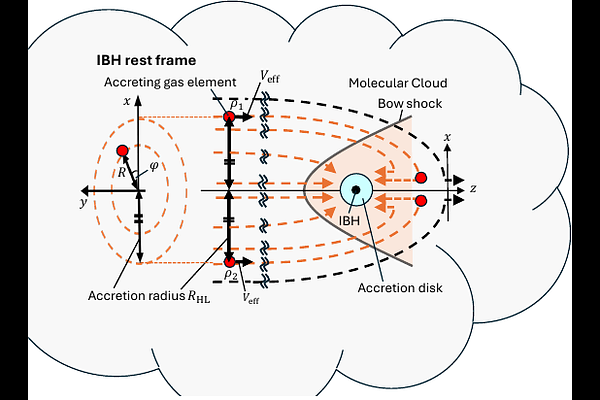
Multi-wavelength Emission Modeling from Accretion Flows around Isolated Black Holes Including Magnetic Flux Transport
Takumi Koshimizu, Shigeo S. Kimura
AbstractIsolated stellar-mass black holes (IBHs) are expected to be abundant in the Milky Way, yet their electromagnetic signatures remain largely undetected. We investigate the detectability of IBHs in molecular clouds using a 1D, multi-wavelength emission model that incorporates magnetic flux transport controlled by the magnetic Prandtl number $P_m$. We find that magnetically arrested disks (MADs) form for $P_m\gtrsim 1$, where the magnetic flux threading the black hole is in a saturation value. On the other hand, MAD formation is restricted to a limited parameter range for $P_m<1$, In our model, outer parts of accretion disks, around 100 gravitational radii, efficiently emit infrared photons detectable by WISE. This feature is not captured by the conventional one-zone model. X-ray emission depends strongly on $P_m$; For $P_m=1$ where MAD is formed, X-ray emission is dominated by nonthermal radiation, whereas inverse Compton emission becomes dominant for $P_m=0.5$ where the magnetic field is weaker than the saturation value. X-ray detection is plausible if they are in dense molecular-cloud filaments for $P_m\ge1$, although it is challenging for $P_m< 1$. These results demonstrate that magnetic flux transport plays a key role in shaping the multiwavelength observational signatures of IBHs.