The Copy-Number Events in Skull Base Chordoma Stratify Tumours into Four Biologically Coherent Groups

The Copy-Number Events in Skull Base Chordoma Stratify Tumours into Four Biologically Coherent Groups
Baluszek, S. P.; Kober, P.; Woroniecka, R.; Malawska, N.; Wagrodzki, M.; Kunicki, J.; Mandat, T.; Grygalewicz, B.; Bujko, M.
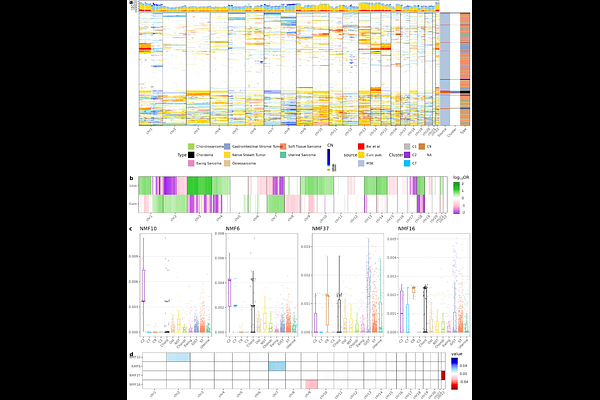
AbstractChordoma, a rare sarcoma of notochordal origin, exhibits slow growth and local aggressiveness. While copy-number (CN) events are recognized as key chordoma drivers, no comprehensive classification, based on CN, has yet been developed. Here, we establish a robust, reproducible genomic subtyping of chordoma, based on CN events. Two independent skull base chordoma cohorts (N=32,N=71) were analyzed, utilizing distinct analytical platforms, DNA methylation microarrays and whole-genome sequencing, both controlled for B-allele frequencies. Samples were clustered using unsupervised hierarchical methods. The CN events defined four consistent molecular clusters across both cohorts: C1 (CN-stable), C9 (chromosomal losses, especially of chr9/CDKN2A), C7 (chr7 gain), and C2 (gains of chr2 and chr7). The findings were validated in fluorescence in situ hybridization (FISH) with concordance of 84-89%. The CN clusters explain 31-33% of the RNA-sequencing transcriptional variance. Moreover, the C2 cluster showed up-regulation of Sonic Hedgehog signaling and clusters C2 and C9 were enriched in cell-cycle-related genes. The proposed CN clusters correlate with existing chordoma classificators e.g. chromosomal instability (CIN), mutation burden, immune score, and methylation clusters. Furthermore, comparison with over 2,000 sarcomas highlighted CN patterns more common in chordoma (i.e. chr1q, chr2, chr7 gains and chr1p, chr3, chr9, chr10, chr13, chr14, chr18 losses) but also revealed shared aberrations, e.g. chr22 loss shared with Gastrointestinal Stromal Tumours (GISTs). This study provides a unifying classification for skull base chordoma, linking distinct genomic architectures to specific transcriptional programs and potential therapeutic vulnerabilities.