How brain pulsations drive solute transport in thecranial subarachnoid space: insights from a toymodel

How brain pulsations drive solute transport in thecranial subarachnoid space: insights from a toymodel
Neff, A.; Vallet, A.; Dvoriashyna, M.
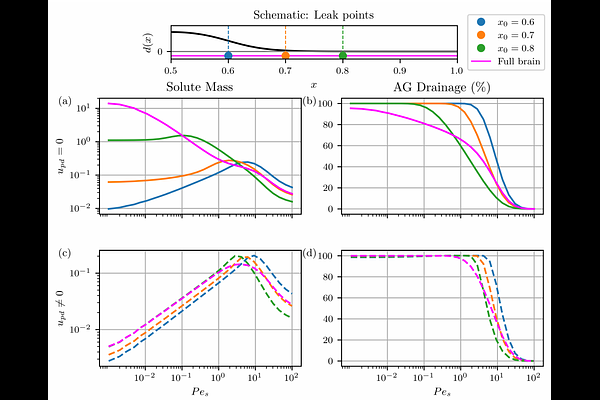
AbstractCerebrospinal fluid (CSF) circulates around and through the brain, supporting neural homeostasis by regulating the extracellular chemical environment. Yet the physical mechanisms governing CSF-driven solute transport remain poorly understood, limiting the design of diagnostic and therapeutic strategies targeting brain clearance and drug delivery. Pulsatile CSF flow in the cranial subarachnoid space (cSAS), is driven by cardiac, respiratory, and sleep-related vasomotion. Over longer timescales weaker steady flows, such as inertial steady streaming, Stokes drift, and production-drainage flow, may contribute to solute transport, but their role and relative importance remain unclear. Here, we develop a simplified two-dimensional model of CSF flow and solute transport in the cSAS using lubrication theory. Through multiple-timescale and asymptotic analyses, we derive a reduced long-time transport equation in which advection is governed by the Lagrangian mean velocity, incorporating steady streaming, production-drainage flow, and Stokes drift. Analysing three physiologically relevant case studies, we show that steady flows can substantially reshape concentration profiles, enhance dispersion, and alter clearance efficiency. Our results clarify the mechanisms underlying CSF-mediated transport, predict distinct regimes in humans and mice, and highlight the importance of subject-specific physiological parameters when interpreting contrast-agent and intrathecal drug-delivery studies.