Establishing Compactness as a Population Observable in Gravitational-Wave Astronomy

Establishing Compactness as a Population Observable in Gravitational-Wave Astronomy
Shrobana Ghosh, Charlie Hoy, Mark Hannam, Frank Ohme
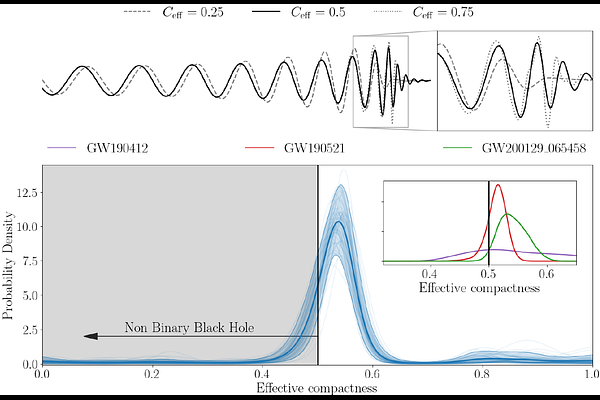
AbstractClassically, black holes (BHs) are the most compact objects predicted in nature with C=0.5 in the Schwarzschild limit; C is defined as the mass-to-radius ratio in geometric units. In this work we perform a novel measurement on the nature of putative BH mergers in the gravitational wave (GW) data by directly probing the binary's closest approach through an effective compactness parameter. We confidently show all such high-significance signals in GWTC-3 are consistent with the BH hypothesis for the first time. Our hierarchical analysis yields $C_{\rm eff} = 0.5^{+0.3}_{-0.1}$, and we further limit the merger rate of low-compactness exotic binaries to $< 0.7\,{\rm Gpc}^{-3}\,{\rm yr}^{-1}$. This work establishes compactness as a key observable in GW astronomy.