Photon Ring Astrometry I: A Simple Spin Measurement Technique for High-Resolution Images of M87*

Photon Ring Astrometry I: A Simple Spin Measurement Technique for High-Resolution Images of M87*
Delilah E. A. Gates, Dominic O. Chang, Aaron Held, Daniel C. M. Palumbo
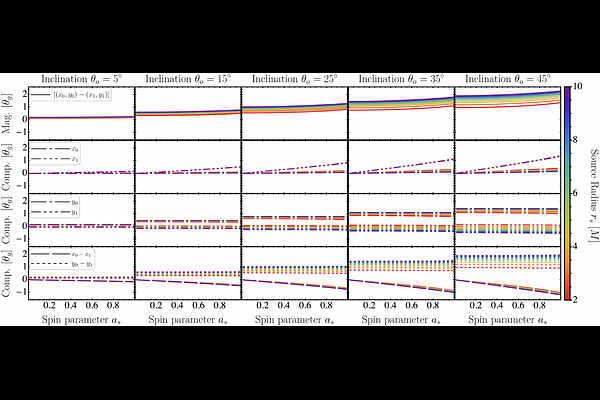
AbstractThe central supermassive black hole of the galaxy M87 is currently a target for precision spin measurement using high-resolution, horizon-scale imaging. Such observations aim to resolve the first lensed (${n}~{=}~{1}$) sub-image of the photon ring from the broader direct image. In this work, we identify a concrete observable -- the displacement between the centers of the ${n}~{=}~{1}$ photon-ring sub-image and the direct image -- and propose its use in a simple spin-measurement technique. Leveraging the assumption that the observed large-scale jet of M87 is aligned with the black-hole spin axis, we separate the relative position of the photon ring into components parallel and transverse to the projected spin axis, normalizing both components with respect to the measured diameter of the ${n}~{=}~{1}$ sub-image. We show that the parallel shift is primarily determined by inclination and emission radius, while the transverse shift is tightly correlated with inclination and spin. We demonstrate these effects both in a simple geometric model (to explain the underlying physics) and in GRMHD simulations with magnetically arrested disks (to provide realistic instantiations of the effect). We find that a relative astrometric resolution of ${\lesssim}~{0.1\;μ\rm{as}}$ is sufficient to constrain the spin to better than 9% if the accretion flow is prograde or 22% if the flow is retrograde. If the direction of the accretion flow is undetermined, the spin can be constrained to within 26%. More generally, this identifies relative photon ring astrometry as a promising method to constrain the underlying spacetime geometry and introduces a spin-constraint technique that does not rely on geometric modeling of the observed emission.