Smoking-gun evidence for hierarchical black-hole mergers

Smoking-gun evidence for hierarchical black-hole mergers
Yin-Jie Li, Yuan-Zhu Wang, Shao-Peng Tang, Yi-Zhong Fan
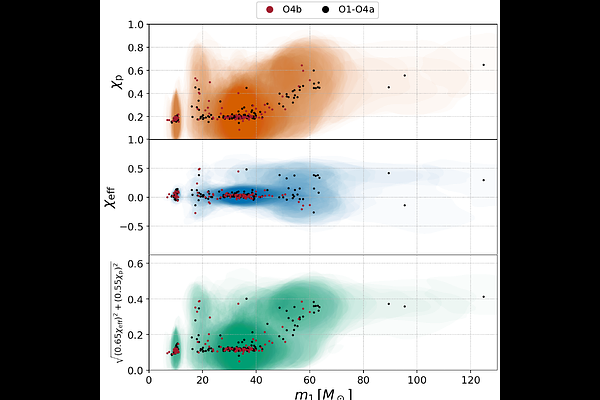
AbstractHow stellar-mass black holes grow after their birth is a central open question in astrophysics. Gravitational-wave observations have revealed a subpopulation of coalescing black holes with both high masses and high spins, but whether these properties arise from hierarchical mergers in dense stellar environments or from accretion onto isolated black holes has remained unresolved. Here, using a flexible mixture population model applied to the 259 binary black hole mergers in GWTC-5, we show that the mass function of the high-spin subpopulation traces, peak by peak, the predicted remnant-mass distribution of the low-spin, stellar-collapse-origin subpopulation up to $\sim80\,M_\odot$. This morphological match, quantified by a Bhattacharyya coefficient as high as $\sim0.95$, is naturally expected if the high-spin black holes are themselves the products of earlier mergers, whereas any alternative scenario would require fine-tuning, thereby providing smoking-gun evidence for hierarchical mergers. In addition, the sharp upper-mass cutoff of the low-spin subpopulation at $m_{\rm max,1}=54.2^{+7.7}_{-7.2}\,M_\odot$ yields an astrophysical $S$-factor of $S_{300}=151^{+30}_{-26}$~keV~b (68\% credible interval) for the $^{12}{\rm C}(α,γ)^{16}{\rm O}$ reaction, in agreement with the benchmark theoretical value. These results establish that the entire observed black-hole population can be accounted for by stellar collapse followed by dynamical hierarchical assembly, without invoking primordial black holes.