Weak-to-Strong Measurement Transition with Thermal Instabilities

Weak-to-Strong Measurement Transition with Thermal Instabilities
Marcos V. S. Lima, Carlos H. S. Vieira, Irismar G. da Paz, Pedro R. Dieguez, Lucas S. Marinho
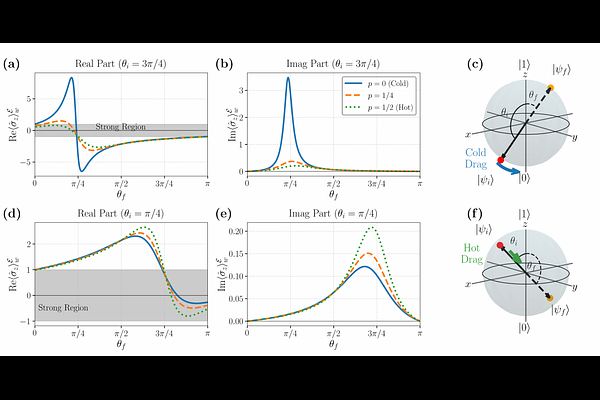
AbstractQuantum measurement is physically realized through a finite dynamical interaction between a system and a measuring apparatus, giving rise to a continuous transition from weak to strong regimes. While this crossover is well understood under ideal conditions, the combined role of thermal instabilities and pre- and post-selection open dynamics has not been systematically addressed. Here, we develop a general framework to analyze the weak-to-strong measurement transition in the simultaneous presence of environmental decoherence and thermal noise. We model the probe as a thermal Gaussian state, explicitly incorporating temperature-dependent fluctuations in the measuring device, and include open-system evolution of the measured system prior to post-selection. By deriving the apparatus's final state, we show that the measurement statistics are modified in a nontrivial, highly sensitive manner by the temperature regime of the system's thermal instabilities, the probe's thermal properties, and the particular choice of pre- and post-selection. This approach allows us to characterize how thermal effects reshape the weak-value condition and influence the emergence of projective behavior across the full measurement crossover.