Integrated Interactomics Reveals Novel Protein Associations: The FOXA1-PBX1 Complex as a Case Study

Integrated Interactomics Reveals Novel Protein Associations: The FOXA1-PBX1 Complex as a Case Study
Chen, Z.; Szepesi-Nagy, I.; Zhang, Q.; Kittane, S.; Gao, Y.; Ortiz-Pacheco, J.; Lane, E.; Hatcher, J.; Estrada, J.; Askenazi, M.; Huang, L.; Ueberheide, B.; Zheng, N.; Toska, E.; Rona, G.; Pagano, M.
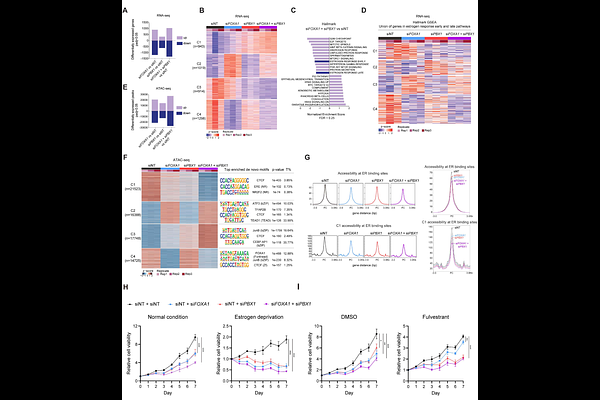
AbstractProtein-protein interactions (PPIs) are fundamental to cellular signaling networks, yet many remain undetected due to technical limitations of individual affinity purification approaches. To address this, we systematically mapped the interaction landscapes of six regulatory proteins involved in cell proliferation, immunity, and inflammation, including three transcription factors (TFs) and three kinases. We implemented an integrated proteomics workflow that combined four complementary affinity purification strategies: native immunoprecipitation, two crosslinking-assisted capture methods, and proximity labeling. Combining these approaches revealed distinct yet overlapping interaction profiles, uncovered numerous previously unreported interactors not reliably detected by individual methods, and robustly recovered known interactions while substantially extending PPI networks. Despite method-specific differences at the protein level, functional enrichment analyses showed strong convergence on coherent biological pathways. Biochemical approaches validated most of the previously unreported interactions, including putative weak and transient complexes stabilized by crosslinking. Functional assays revealed a previously unrecognized physical interaction between FOXA1 and PBX1 TFs and demonstrated their cooperative regulation of transcriptional programs and cell fitness in estrogen receptor (ER) positive breast cells. We propose that the FOXA1-PBX1 complex could represent a higher-order regulatory node integrating chromatin accessibility and ER-driven transcriptional output.