Moderately Reduced Contractility Decreases Epithelial Cell-Cell Contact Rupture Under Large External Stretch

Moderately Reduced Contractility Decreases Epithelial Cell-Cell Contact Rupture Under Large External Stretch
Sharmin, S.; Obermeyer, C.; Maruthamuthu, V.
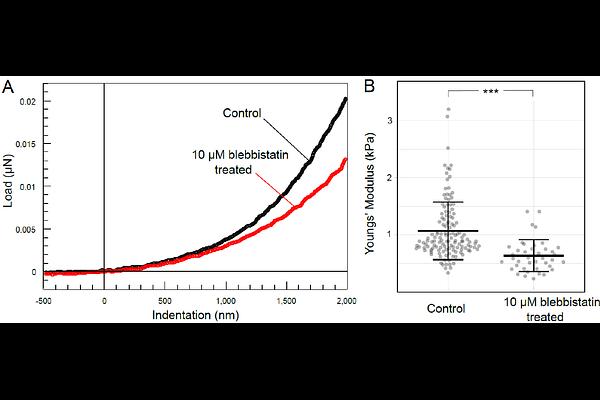
AbstractEpithelial sheets must maintain robust barrier function while enduring severe mechanical deformations across various physiological environments. While baseline actomyosin contractility is understood to stabilize intercellular junctions and hence cell-cell contact integrity, how cell-generated active forces interact with external physical strain to dictate contact integrity remains poorly understood. In this study, we investigated the biophysical trade-offs between actomyosin contractility and barrier resilience when Madin-Darby Canine Kidney (MDCK) cell islands are subject to large stretch. In contrast to a high concentration (50 M) of the non-muscle myosin II inhibitor blebbistatin that disrupted cell-cell contacts, we first identified a lower concentration (10 M) that maintained cell-cell contact integrity in the absence of any stretch. Such moderate inhibition of non-muscle myosin II reduced, but preserved some level of actin bundle organization. Remarkably, when challenged with a pathological 38% linear stretch using a custom-built biaxial stretching device, 10 M blebbistatin treated epithelial islands exhibited significantly fewer cell-cell contact ruptures than untreated controls, demonstrating a potent protective effect against mechanical strain. Traction force microscopy revealed diminished cell-generated strain energy by over 60% indicating a partial but significant reduction in contractility upon 10 M blebbistatin treatment. Nanoindentation measurements revealed that moderate contractility inhibition decreased the cellular Young's modulus by more than 40%. Consequently, moderate contractility inhibition safeguards epithelial junctions through a dual mechanical effect: it simultaneously reduces baseline active tensile stresses due to cell contractility and lowers the passive elastic forces generated within the softened cell island during external stretch. Our findings indicate that this systemic reduction in forces dominates over any loss of biochemical adhesion strength at cell-cell contacts. We propose that shifting the epithelium from a rigid, highly stressed continuum to a more compliant, relaxed state by moderate contractility inhibition can serve as a general biophysical mechanism to preserve barrier integrity under severe mechanical challenge.