Stage- and tissue-specific gene editing using 4-OHT inducible Cas9 in whole organism

Stage- and tissue-specific gene editing using 4-OHT inducible Cas9 in whole organism
Li, Y.; Zhang, W.; Wei, Z.; Li, H.; Liu, X.; Zheng, T.; Aziz, T.; Xing, C.; Meng, A.; Wu, X.
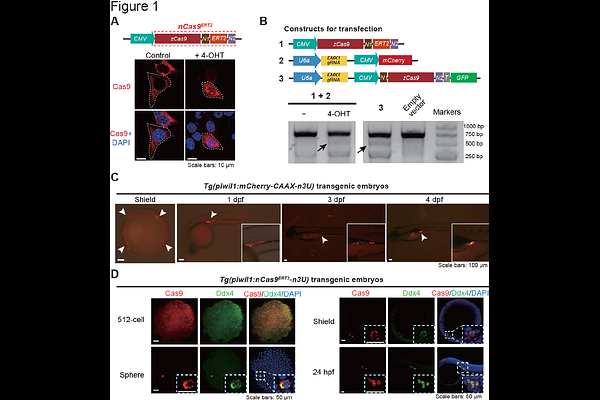
AbstractVertebrate genes usually function in specific tissues at specific stages, and thus their functional studies require conditional knockout or editing. In the zebrafish, spatiotemporally inducible genome editing, especially during early embryonic development, is still challenging. Here, we report inducible Cas9-based gene editing in specific cell types at desired stages in zebrafish. We show that the nCas9ERT2 fusion protein consisting of Cas9 and estrogen receptor flanked by two nuclear localization signals is normally located in the cytoplasm and efficiently translocated into the nucleus upon 4-hydroxytamoxifen (4-OHT) treatment in cultured cells or embryos. As a proof-of-concept, we demonstrate that target genes in primordial germ cells or germ cells of transgenic zebrafish embryos or adults with stable expression of nCas9ERT2 and gene-specific guide RNAs (gRNAs) can be induced to mutate by application of 4-OHT. This inducible nCas9ERT2 system also works in mouse early embryos. Thus, this inducible gene editing approach will be another choice for studying the temporospatial function of genes at the organismal level. Hence, the inducible nCas9ERT2 system expands the tissue- and stage-specific gene editing toolkit.