Multiband ALMA polarimetry of the jet base and kiloparsec-scale jet of 3C 273: A multicomponent Faraday structure in the nucleus

Multiband ALMA polarimetry of the jet base and kiloparsec-scale jet of 3C 273: A multicomponent Faraday structure in the nucleus
T. Hovatta, S. P. O'Sullivan, I. Marti-Vidal, T. Savolainen
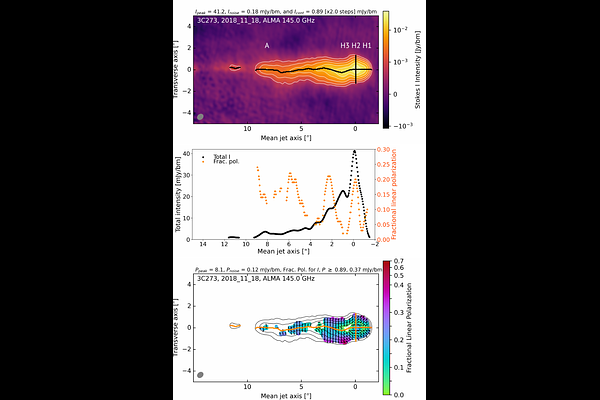
AbstractPolarization observations at millimeter wavelengths can be used to study magnetized plasma in jets launched by supermassive black holes. We used multiband Atacama Large Millimeter Array (ALMA) data to study the polarization structure of both the nucleus and the kiloparsec-scale jet of the archetypal quasar 3C 273. We modeled the wavelength-dependent polarization of the nucleus using multiband observations (2, 1.3, and 0.85 mm) and applied QU-fitting to constrain Faraday rotation models with one or more polarized components. We also produced total intensity and polarization maps of the kiloparsec-scale jet to study the evolution of the magnetic field structure along and across the jet. The data of the nucleus were best fit by two Faraday components: a high rotation measure (RM) component with RM = +(2.6 +/- 0.1) x 10^5 rad/m^2 and comparable RM dispersion, and a second component with RM = +(1.5 +/- 0.2) x 10^4 rad/m^2 and lower dispersion. The high RM is comparable to previous ALMA observations at 1.3 mm, although we found clear evidence of variability when compared to previous single-band ALMA studies, highlighting the importance of broad wavelength coverage. On kiloparsec scales, the millimeter polarization structure closely resembled that observed at centimeter wavelengths, revealing a complex magnetic field configuration around the jet head and brightest hotspot region. Our results indicate a multicomponent, time-variable Faraday screen in the nuclear region of 3C 273 that is likely associated with a dense, magnetized environment close to the jet base. Future spatially resolved millimeter polarimetry with the Event Horizon Telescope will be crucial to disentangling these components and directly localizing the high-RM emission region.