A Short-Timescale Optical Quasi-Periodic Oscillation in PKS\,0805$-$07 from High-Cadence TESS Observations

A Short-Timescale Optical Quasi-Periodic Oscillation in PKS\,0805$-$07 from High-Cadence TESS Observations
Sikandar Akbar, Zahir Shah, Naseer Iqbal
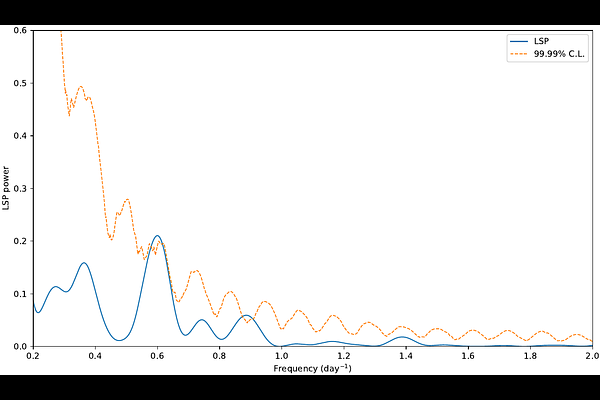
AbstractWe present a timing analysis of the high-cadence optical light curve of the high-redshift flat-spectrum radio quasar PKS\,0805$-$07 obtained during \textit{TESS} Sector~34 (MJD $59230.90$--$59239.90$). We search for short-timescale quasi-periodic oscillations (QPOs) using complementary time-series techniques, including the Lomb--Scargle periodogram (LSP) and the weighted wavelet $Z$-transform (WWZ), and evaluate their significance against red-noise variability using Monte Carlo simulations. The LSP reveals a dominant modulation at $f \approx 0.597\,\mathrm{d^{-1}}$ ($P \approx 1.7\,\mathrm{d}$) exceeding the $99.99\%$ confidence level, while the WWZ independently recovers a consistent timescale at the $\sim 99.9\%$ level and shows that the signal is temporally localized rather than persistent across the full light curve. The modulation spans $\sim 5$ coherent cycles, indicating a transient quasi-periodic feature. We discuss possible physical interpretations of the detected modulation. In a disk-based scenario, orbital motion of a hotspot near the innermost stable circular orbit implies a black hole mass of $M_{\rm BH}\sim7.2\times10^{8}\,M_\odot$, consistent with typical FSRQ values. Alternatively, magnetohydrodynamic kink instabilities in the relativistic jet can naturally produce day-scale variability for standard blazar parameters and account for the transient character of the signal. We conclude that the observed modulation is consistent with a compact, short-lived structure embedded within stochastic jet variability.