Sensitivity of the Cherenkov Telescope Array Observatory to Gamma-Ray Signals in Dwarf Irregular Galaxies

Sensitivity of the Cherenkov Telescope Array Observatory to Gamma-Ray Signals in Dwarf Irregular Galaxies
Jaume Zuriaga-Puig, Viviana Gammaldi, Miguel Á. Sánchez-Conde
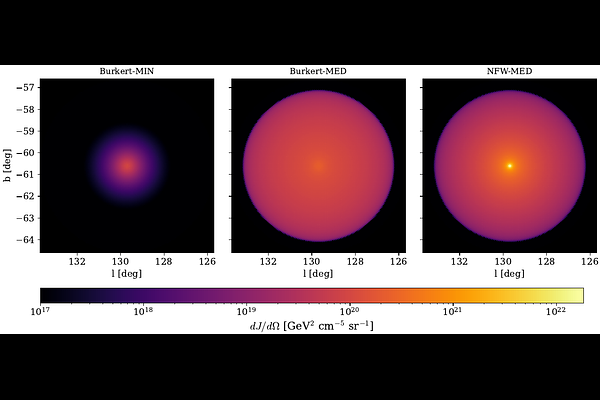
AbstractDwarf irregular galaxies (dIrrs) are rotationally supported galaxies with a low star formation rate. Thus, their gamma-ray astrophysical emission is expected to be low, making them interesting targets for WIMP dark matter (DM) indirect searches. In this work, we build upon previous work on these objects in this DM context, and identify the best four dIrrs to be observed by the forthcoming Cherenkov Telescope Array Observatory (CTAO). Since dIrrs have not been detected in gamma rays yet, we first explore the prospects for detecting their astrophysical emission with the CTAO. Secondly, we compute the CTAO sensitivity prospects to a DM annihilating signal from these objects, accounting for the presence of DM substructures in them. We do so for both cuspy and cored DM density profiles, as the cusp-core debate remains particularly open for dIrrs. Our best combined limits show the potential to exclude DM annihilation cross-section values around $2\times 10^{-24} \ \mathrm{cm^{3}}\mathrm{s^{-1}}$ for 100 GeV WIMP masses annihilating in the $τ^+τ^-$ channel. These prospective results are competitive with and complementary to benchmark targets such as galaxy clusters. We also analyze the case of the velocity-dependent annihilation cross-section (Sommerfeld enhancement), obtaining projected DM constraints that exceed those expected for dwarf spheroidal galaxies, thanks to the contribution of subhalos to the signal. We conclude that dIrrs are compelling targets for the CTAO, not only for DM indirect searches but also as possible astrophysical sources.