Neutrino transport and flavor instabilities in a post-merger disk

Neutrino transport and flavor instabilities in a post-merger disk
Erick Urquilla, Swapnil Shankar, Debraj Kundu, Julien Froustey, Sherwood Richers, Jonah M. Miller, Gail C. McLaughlin, James P. Kneller, Francois Foucart
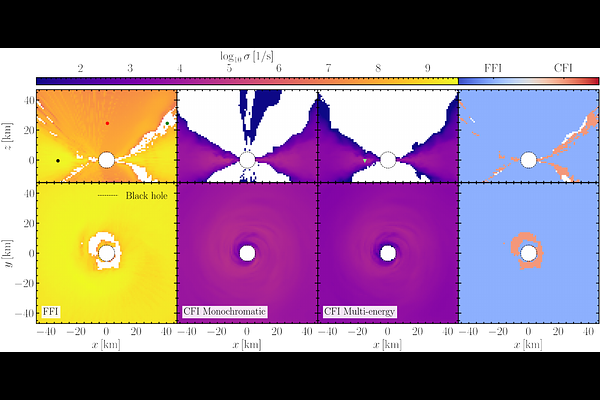
AbstractNeutron star mergers are multimessenger sources whose dynamics and signals depend critically on neutrinos and their flavor transformations. We investigate whether fast and collisional neutrino flavor instabilities (FFIs and CFIs) arise in a GW170817-like post-merger accretion disk, and how they develop and relax, by performing global and local classical and quantum-kinetic simulations that resolve anisotropies and inhomogeneities in the full six-dimensional phase space. In the accretion disk, the neutrino radiation field naturally develops electron-lepton-number crossings through the interplay between the more isotropic electron neutrino field and the more anisotropic electron antineutrino field. The neutrino field in the disk is also unstable to CFI, although on longer timescales than the FFI. Using local, multi-energy quantum-kinetic calculations at selected points, we find that the growth of unstable modes is well-predicted by a fully anisotropic linear stability analysis and the flavor transformation increases the heavy lepton neutrino fluxes. CFI likewise enhances heavy-flavor fluxes, shows significant impacts from the growth of multi-energy anisotropic modes, and breaks the symmetry of the heavy-flavor sector by raising the average energy of heavy-flavor antineutrinos above that of heavy-flavor neutrinos. However, the CFI remains subdominant to the FFI in most of the disk. In our global quantum-kinetic simulations with an attenuated Hamiltonian, flavor coherence develops primarily in the polar regions. Because the attenuation causes advection to outpace the growth of the instabilities, coherence and flavor conversion remain artificially suppressed within the disk. These results emphasize the resolution and scaling requirements for future global simulations that capture instability growth, saturation, and advection simultaneously.