Biophysical Characterization of ParBS Condensates suggests a physical mechanism for segregation

Biophysical Characterization of ParBS Condensates suggests a physical mechanism for segregation
Gupta, R.; Ucuncuoglu, S.; Childers, W. S.; Dunlap, D.; Finzi, L.
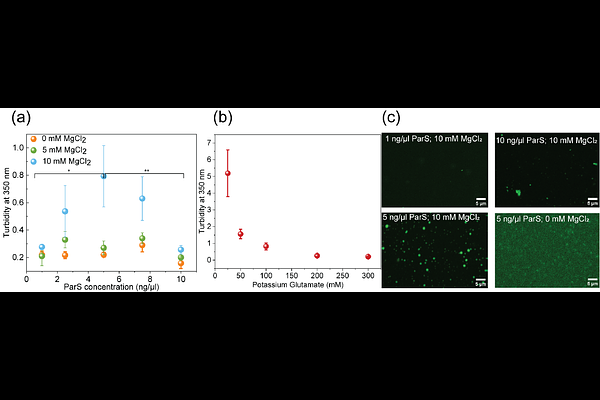
AbstractThe ParABS system orchestrates chromosome segregation in many bacterial species. The centromere-like parS sites serve as nucleation points for the initial binding of the ParB protein. Subsequent diffusion on adjacent, non-specific DNA regions (spreading) in the presence of CTP and binding of more ParB molecules along with DNA looping via ParB-ParB interactions bring distal parts of the chromosome into proximity. ParB interaction with the ParA-ATPase motor protein, then, drives genomic segregation. It has been shown that in some bacterial species, the ParB-parS complex undergoes phase separation into a condensate. However, the physico-chemical properties of such condensates and their response to forces, such as those they may face in the cell, have not yet been characterized. Performing turbidity measurements in the presence of CTP and various concentrations of DNA and physiologically relevant mono and divalent salt It was shown that Mg2+ facilitates, while K+ concentrations higher than ~20 mM disfavors, condensate formation. Microrheology measurements showed that condensates of ParB and DNA including parS sites (ParB-parS DNA) in the presence of CTP, are viscoelastic with a viscosity at Troom of ~5 Pa s and able to quickly respond to deformations with a network relaxation time of 0.1 s. Additionally, fluorescence combined with force spectroscopy showed that mechanical disruption of ParB-DNA condensates in the presence of CTP requires ~ 5-7.5 pN of tension in the DNA, which is lower than the force required to stall a molecular motor such as RNA polymerase, but higher than the force required for the relocation of chromosomes and plasmids during segregation. These results support the idea that ParB-parS condensates dynamically rearrange at the molecular level while maintaining the cohesion necessary to sustain the drag force of segregation without interfering with genomic transactions. This physical mechanism could be the basis for the critical role of ParB-parS condensates in organizing and partitioning bacterial chromosomes.