Learning the spatial cell-cell communication network to decode multi-channel signaling and predict network-hub vulnerabilities with MOSANIC

Learning the spatial cell-cell communication network to decode multi-channel signaling and predict network-hub vulnerabilities with MOSANIC
Das, D.; Mitra, P.
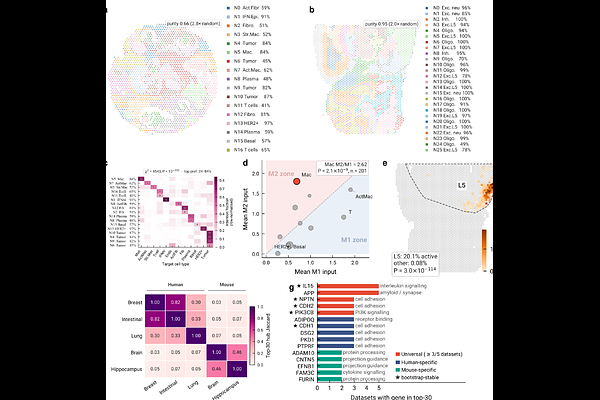
AbstractIntercellular signaling governs the central decisions of tissue biology, from proliferation and immune recruitment to metabolic adaptation and cell death, and its dysregulation is a hallmark of disease. What matters most are properties of the signaling network as a whole rather than of individual interactions: the hubs that hold the network together and mark rational points of intervention, the relays through which a signal propagates across intermediate cells to reach partners it does not directly contact, the response of tissue-wide communication to the loss of a single node, and the metabolite-mediated axis that operates alongside secreted-protein signalling. Scoring known ligand-receptor pairs yields a ranked interaction list that captures none of these and excludes metabolite signalling. We present MOSANIC (Multi-mOdal Self-Attention Network for Intercellular Communication), which learns a tissue's communication network directly from spatial transcriptomics. MOSANIC represents each tissue as a single heterogeneous graph of cells, genes and metabolites, initialises every node with a frozen foundation-model representation (scVI, ESM-2 and ChemBERTa), and propagates these representations through a self-attention network over biologically typed edges. Supervision is restricted to spatial gene-expression prediction and excludes ligand-receptor annotation, rendering the inferred communication statistically independent of the reference databases used for evaluation. Across five spatial datasets spanning three platforms and two species, MOSANIC attains the highest accuracy on all eight independent ligand-receptor benchmarks (mean AUROC 0.756) against nine established methods, resolves a metabolite-receptor channel statistically orthogonal to the peptide channel, and reconstructs multi-step signal relays that concentrate within a compact rich-core of load-bearing hub genes and cells whose removal fragments the network far beyond a degree-preserving null. In-silico knockout of these hubs recovers experimentally reported phenotypes, and, given no prior oncological input, MOSANIC nominates SCARF1 as a previously unrecognised communication hub in breast cancer whose elevated expression predicts significantly worse survival in an independent cohort after adjustment for tumour stage and age (hazard ratio 1.17, P = 0.043). MOSANIC is released as an open-source Python package (mosanic-ccc).