Fisher Glasses: Tail-Certified Quantum Metrology in Quenched Environments

Fisher Glasses: Tail-Certified Quantum Metrology in Quenched Environments
El Mustapha Mansouri, Keigo Arai
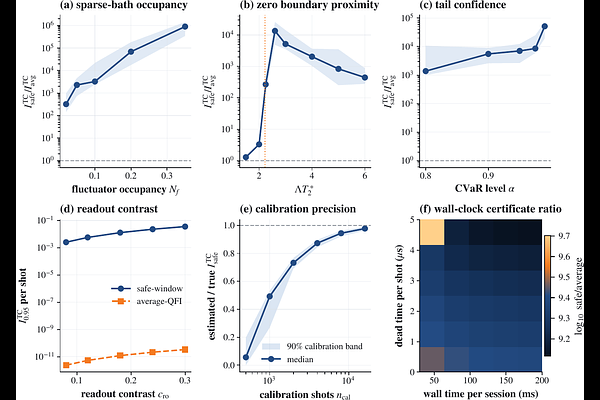
AbstractQuantum metrological advantage is certified by averaged Fisher responses: contrast, susceptibility, or quantum Fisher information (QFI). This fails in quenched sensors, where slow environmental variables freeze within a session but vary between repetitions: shallow nitrogen-vacancy (NV) centers, superconducting qubits with slow two-level fluctuators, and semiconductor spin qubits in drifting charge noise. They sample session-resolved Fisher geometries, not an averaged channel. Certification conditions on the latent session, projects nuisance directions, inverts to attainable loss, then tail-certifies; this inverse upper-tail loss defines quenched tail-certified information. A no-go theorem: no averaged Fisher data determine this certificate; ensembles sharing averaged Fisher matrix, QFI, and projected information have finite or zero certified precision. A Fisher-zero integrability transition governs collapse: the inverse-loss tail exponent $β$ sets the boundary, with nonintegrable certified loss for $β\le 1$, even when annealed information is large or scaling. The certified quantum resource is response transverse to latent disorder, not raw amplification sharing its generator; universal design laws: safe windows, nondegenerate portfolios, Fisher reserves, action separation, Fisher-cut criteria. A shallow-NV Ramsey tournament shows average-QFI optimization is tail-catastrophic, whereas tail-certified designs recover nearly three orders of magnitude in certified information at equal shot budget and latent ensemble. These non-self-averaging phases are Fisher glasses, governed by Fisher-zero rare-event statistics.