Model Ensembling and Machine Learning Approaches to Predict the First Dose of Amoxicillin in Intensive Care

Model Ensembling and Machine Learning Approaches to Predict the First Dose of Amoxicillin in Intensive Care
Mihaly, L.; Gregoire, N.; Magreault, S.; Franck, B.; Krekounian, O.; Woillard, J.-B.; Aranzana-Climent, V.
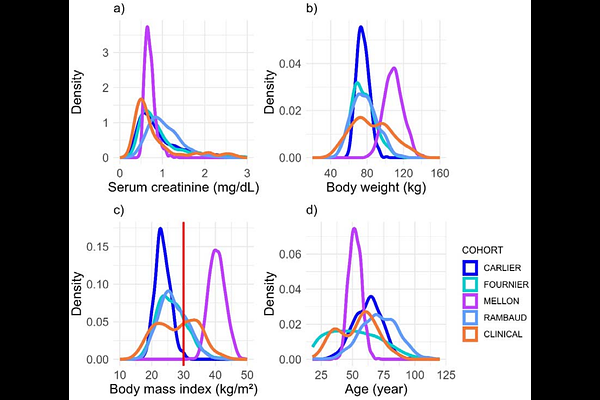
AbstractA priori model informed precision dosing (MIPD) recommends an appropriate first dose based solely on the covariates of the patient enabling faster target attainment without required concentration measurements. Population pharmacokinetic model ensembling and machine learning (ML) approaches were developed and evaluated to predict a first dose of amoxicillin in intensive care. Following a bibliographic review, a virtual patient population was simulated based on cohorts from four published adult amoxicillin PopPK models. Model-development cohorts were reproduced, and steady-state trough concentrations were simulated using cohort-specific dosing regimens. As reference methods, weighted model ensembling (WME) and classification tree (CT)-informed ensembling were implemented. Two novel ensembling strategies were developed: regression tree (RT)-informed ensembling, using RT to predict the log individual prediction/observation ratio, and factor analysis of mixed data (FAMD), assigning model weights based on patient similarity to original model cohorts. In parallel, four ML algorithms (support vector machine, k-nearest neighbors, random forest, and XGBoost) were trained to predict the dose achieving target concentrations based on covariates and dosing scheme. All approaches were compared with single-model PopPK dosing, standard dosing, and a nomogram, and externally validated using clinical data. Most MIPD methods outperformed standard dosing. On simulated data, ensembling (30-42 % correct predictions) and ML (36-39 %) exceeded single-model approaches (14-32 %). RT-informed and FAMD ensembling improved performance by 6-10 % over uninformed ensembling on clinical data. In clinical patients receiving continuous infusion, ensembling further improved performance, with FAMD achieving 49 % correct predictions. ML-based ensembling eliminates the need for model selection and increase target attainment.