Comparative Analysis of Transposable Elements in Hermetia illucens

Comparative Analysis of Transposable Elements in Hermetia illucens
Hector Rosche-Flores, H.; Fischer, S.; Picard, C. J.
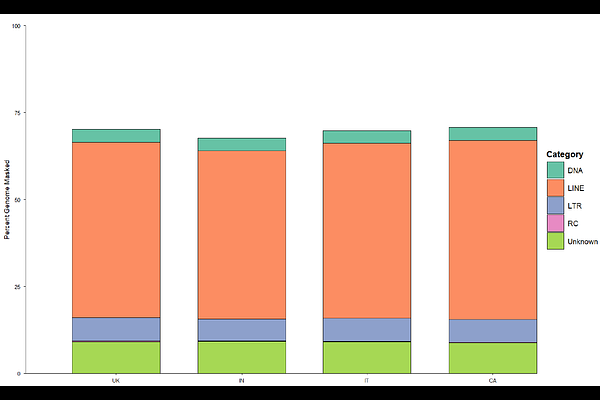
AbstractBackground The black soldier fly (Hermetia illucens) is an emerging model for bioconversion and industrial rearing. Its genome is highly repetitive, yet the contribution of transposable elements (TEs) to population divergence and demographic processes. The sampled populations represent a gradient of demographic histories, including wild and near-wild North American populations, and domesticated European strains with shared industrial origins. Difference in TE composition may influence genome structure, regulatory variation, and evolutionary responses to captive environments. Results A comparative analysis of the repetitive landscape was done for four H. illucens genomes, one of which is a wild-caught specimen. Total repeat content was high across all assemblies (67.6% to 70.8%) and dominated by LINE elements. Class-level TE diversity was nearly identical among genomes, but multiple DNA transposon families showed distinct lineage-specific differences. Large families including Maverick and Academ were generally depleted relative to the wild sample. Divergence profiles revealed patterns consistent with recent turnover in several families. Family level turnover, rather than class level change, accounted for the most difference among the genomes. TE-associated structural variants (TESVs) were also not uniformly distributed. Most chromosomes showed mid-chromosome enrichment, and a pronounced TESV peak on chromosome 5 overlapped a histone rich region containing many unclassified repeats. Use of a repeat library derived from multiple genomes increased the number of detected TESVs and improved classification within complex regions, demonstrating that multi-genome libraries enhance annotation accuracy compared to single reference-based models. Conclusions Multiple DNA transposon families show evidence of recent or lineage-specific amplification in H. illucens, suggesting that TE amplification contributes to genome variation during demography-associated TE turnover. The multi-genome-based library improved TE detection and classification, providing a proof of concept that even a small lineage-inclusive repeat library enhances annotation accuracy and capture TE diversity missed by single-reference approaches. Together, these findings demonstrate that TE family turnover plays a significant role in shaping genome architecture and adaptation in this species. Keywords: Hermetia illucens, transposable elements, demographic processes, structural variants