A de novo designed enzyme for photo-proximity labeling of E3 ligase neighborhoods in live cells

A de novo designed enzyme for photo-proximity labeling of E3 ligase neighborhoods in live cells
Kim, N. H.; Lin, Z.; Nam, S.; Swaney, D.; Krogan, N.; Kim, Y. H.; Therien, M. J.; DeGrado, W. F.; Wells, J. A.
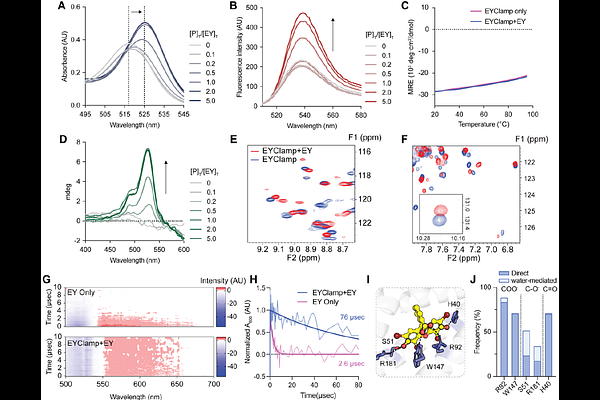
AbstractPhotocatalytic proximity labeling proteomics (photo-PLP) has emerged as a powerful technology for rapid capture of protein interactomes in situ. Typically, photo-PLP relies on chemical conjugation of the photocatalyst to the target of interest which creates practical challenges for derivatized photocatalyst synthesis and bioconjugation specificity. Integrating the precision of genetically encodable enzymes with the versatility of chemically defined photocatalysts provides a modular approach to further expand the scope of neighborhood mapping. Here, we present EYClamp, a de novo designed proximity labeling enzyme harnessing the off-the-shelf photocatalyst Eosin Y (EY) as a cofactor. Using a domain-swapped dimer architecture, we designed a scaffold that binds EY with high affinity (Kd = 10 nM) and lengthens its triplet excited-state lifetime by 29-fold. EYClamp enables efficient, multi-scale photocatalytic proximity labeling in live cells with aryl-diazirine-, aryl-azide- and phenol-biotin. We genetically fused EYClamp to a panel of six important E3 ligases. Using EYClamp, we identified over 1,500 candidate neighbors for KEAP1, MDM2, ASB7 and STUB1, providing a broad and unbiased view of these important neighborhoods. Critical functional networks were revealed including ASB7 engagement with HP1a/CUL5 complex for heterochromatin remodeling. Our EYClamp provides a genetically encodable plug-and-play solution for photo-PLP interactome discovery of the large family of E3 ligases and establishes domain-swapping as a promising strategy for de novo photoenzyme design.