Significant or Not? The Impact of Randomisation During Data Reduction on Confirming a New Pulsating Ultraluminous X-ray Source Candidate in Centaurus A

Significant or Not? The Impact of Randomisation During Data Reduction on Confirming a New Pulsating Ultraluminous X-ray Source Candidate in Centaurus A
Amy H. Knight, Timothy P. Roberts, Callum Potter, Alistair T. Pagan, Dominic J. Walton
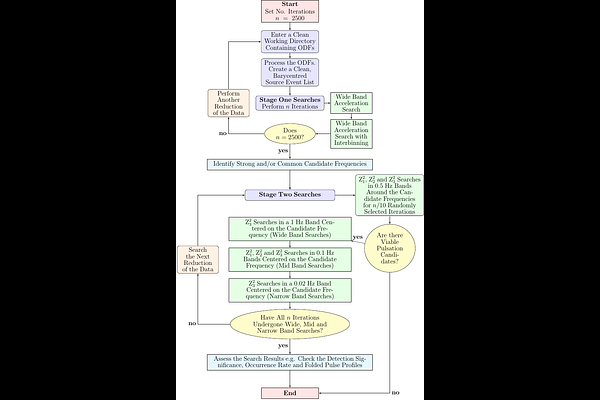
AbstractWe report the discovery of a new candidate pulsating ultraluminous X-ray source (PULX) in NGC 5128 (Centaurus A). The candidate, 4XMM J132542.2-425943, is a transient source, identifiable as a clear X-ray point source for $\sim 8$ months in 2014, during its only major recorded outburst. The source flux exceeded $10^{-12}$ erg cm$^{-2}$ s$^{-1}$ at the peak of the outburst. The long-term light curve of 4XMM J132542.2-425943 shows two further, less luminous detections in 2017 and 2024, but was otherwise in quiescence. This behaviour is similar to the class of pulsating transients with outbursts that reach the ultraluminous regime, which includes the well-studied Galactic PULX, Swift J0243.6+6124. However, 4XMM J132542.2-425943 displays a soft X-ray spectrum, making this source distinct from the existing population of PULXs, which typically show hard spectra below $10$ keV. We searched the 2014 XMM-Newton observations for X-ray pulsations, revealing coherent, sinusoidal X-ray pulsations at a frequency of $1.27$ Hz in one XMM-Newton observation (ObsID 0724060801), at a marginal significance. For this signal we measure a pulsed fraction, PF$\approx~15 - 17~\%$ and $\dot{f}~\sim~4~\times~10^{-9}$ Hz s$^{-1}$. However, we find that the intrinsic randomisation employed by XMM-Newton's Science Analysis Software, XMM-SAS, during the data reduction procedure introduces considerable uncertainty in the strength of our marginal pulsations, which varies significantly between consecutive data reduction iterations. We explore the impact of this randomisation and demonstrate that it can generate widespread false positives and false negatives, which, in the context of PULX searches, may cause viable candidates to be unnecessarily discarded or vice versa.