Pulse Quality Optimisation in Quantum Optimal Control

Pulse Quality Optimisation in Quantum Optimal Control
Dylan Lewis, Roeland Wiersema
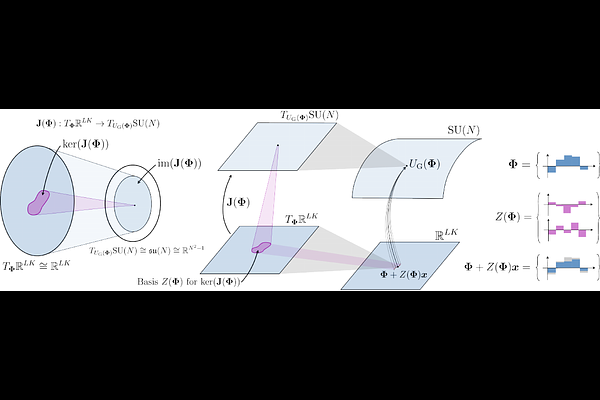
AbstractQuantum optimal control methods are widely used to design experimental control pulses such as laser amplitudes, phases, or detunings, that implement a target unitary evolution. In practice, what makes a pulse "good" depends not only on its fidelity, but also on the experimental setting and the relevant hardware constraints. Here, we introduce geometric quantum control with kernel optimisation (GECKO), a model-agnostic method for improving control pulses after a high-fidelity solution has been found. GECKO uses the Riemannian geometry of the special unitary group to identify directions in pulse space that leave the implemented unitary unchanged to first order, allowing one to traverse level sets of the control landscape while optimising a chosen differentiable pulse-quality function. We demonstrate GECKO on a transverse-field Ising Hamiltonian implementing CZ and CNOT gates, optimising pulse properties including spectral filtering, smoothness, robustness to parameter deviations, and pulse duration. In all cases, GECKO finds substantially improved pulse solutions.